
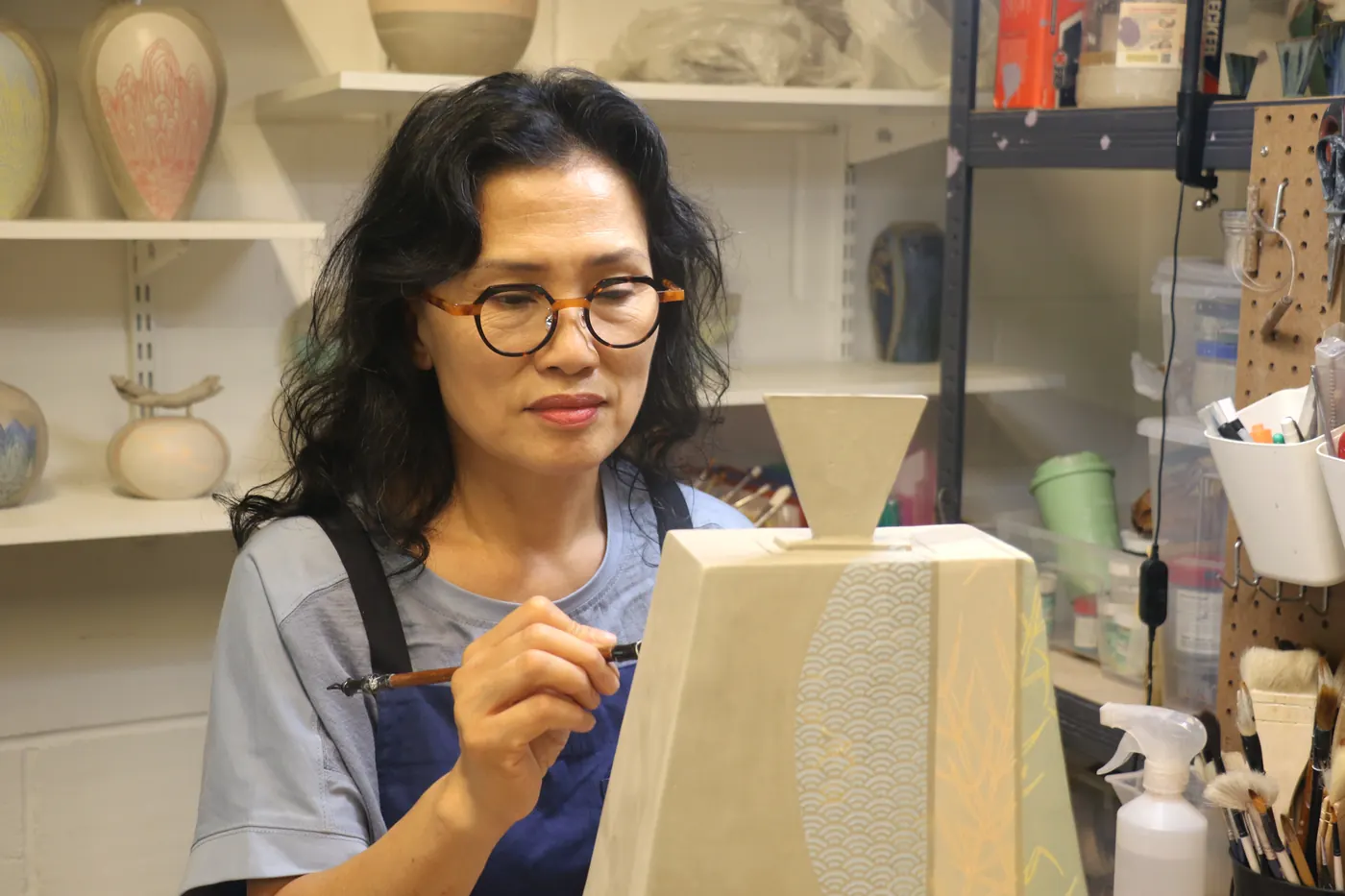
For several years Miae Kim had one shelf. It was in a membership studio in central London, the kind you pay to share, and when a piece of hers went into the kiln somebody else decided where it stood and how it was fired.
She had spent the twenty years before that in Los Angeles, working on films. Space Jam, The Iron Giant, Osmosis Jones, Sky Captain and the World of Tomorrow, The SpongeBob SquarePants Movie, The Simpsons Movie. Effects and compositing at first, later supervision.
Nothing belonged to anybody
Film work is collective by construction.
You may spend weeks or months on one small part of a much larger production, and that work is passed through many other hands before it becomes the finished thing. There are directors, supervisors, producers, other artists and technical departments, and endless revisions. Nothing really belongs to one person.
Miae KimWhat she took from it into clay was patience, close observation, composition, layering, and a willingness to spend an unreasonable amount of time on small things. Years of working frame by frame had taught her how small changes accumulate into large ones.
What she had to put down was the undo.
In digital work, almost anything can be undone, adjusted or replaced. Ceramics does not give you that comfort. At some point you have to stop touching it, put it into the kiln and accept that the material and the fire will have the final say.
Miae KimShe discovered clay in Los Angeles, took the ceramics programme at Glendale College and finished it in 2018, then worked out of a small studio at home. In 2020 her husband's work brought the two of them to London. It is the fourth country she has lived in.
A margin for uncertainty
In the shared studio the firing was not hers. She did not design the work around that, exactly, but she learned to leave room in it: to be wary of effects that need precise conditions, and to accept that some part of a surface would be decided by somebody else's loading.
Space turned out to matter more than the kiln. One shelf means a small number of pieces, and a small number of pieces changes what you do with each.
If I was only going to make a limited number of pieces, I tended to spend much more time on each one.
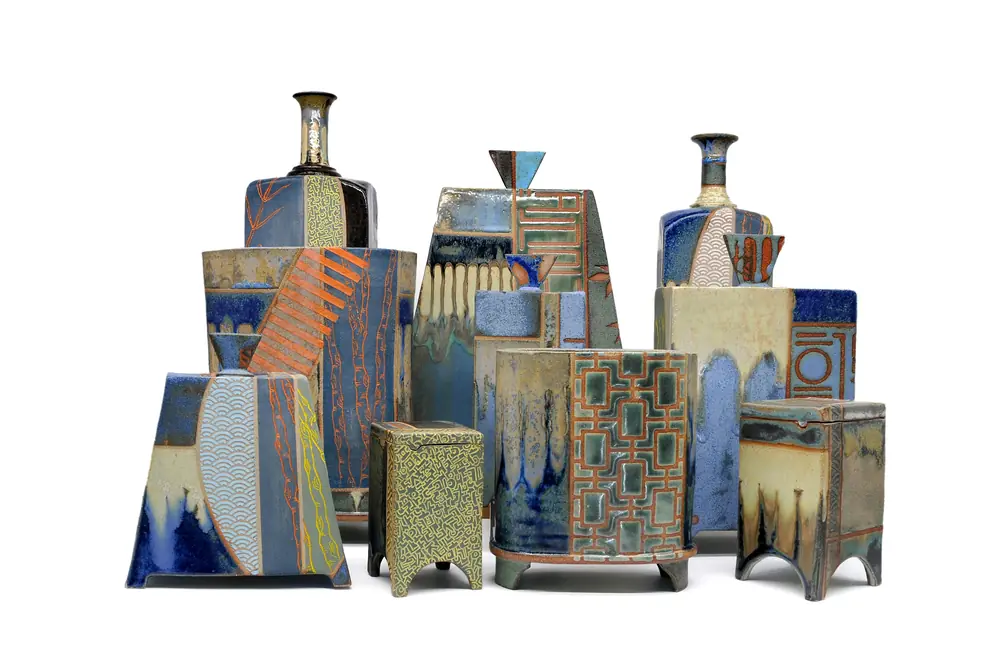
Miae KimThat is where the density came from — the carving, the inlay, the layered surfaces that make a twenty-centimetre box look bigger than it is. At the time it did not feel like a decision at all. Her situation in Britain felt temporary for a long while, and she did not want to sink money into equipment for a life that might move again.
There was a second loss of control, which shaped the boxes just as much. She had been firing them raku, where the fire and the smoke finish the piece for you. When raku became hard to get at she moved the work into the surface instead: inlay, sgraffito cut freehand into painted terra sigillata, glaze laid on by hand, decals she designs herself. The decoration grew where the fire had been.
Two artists
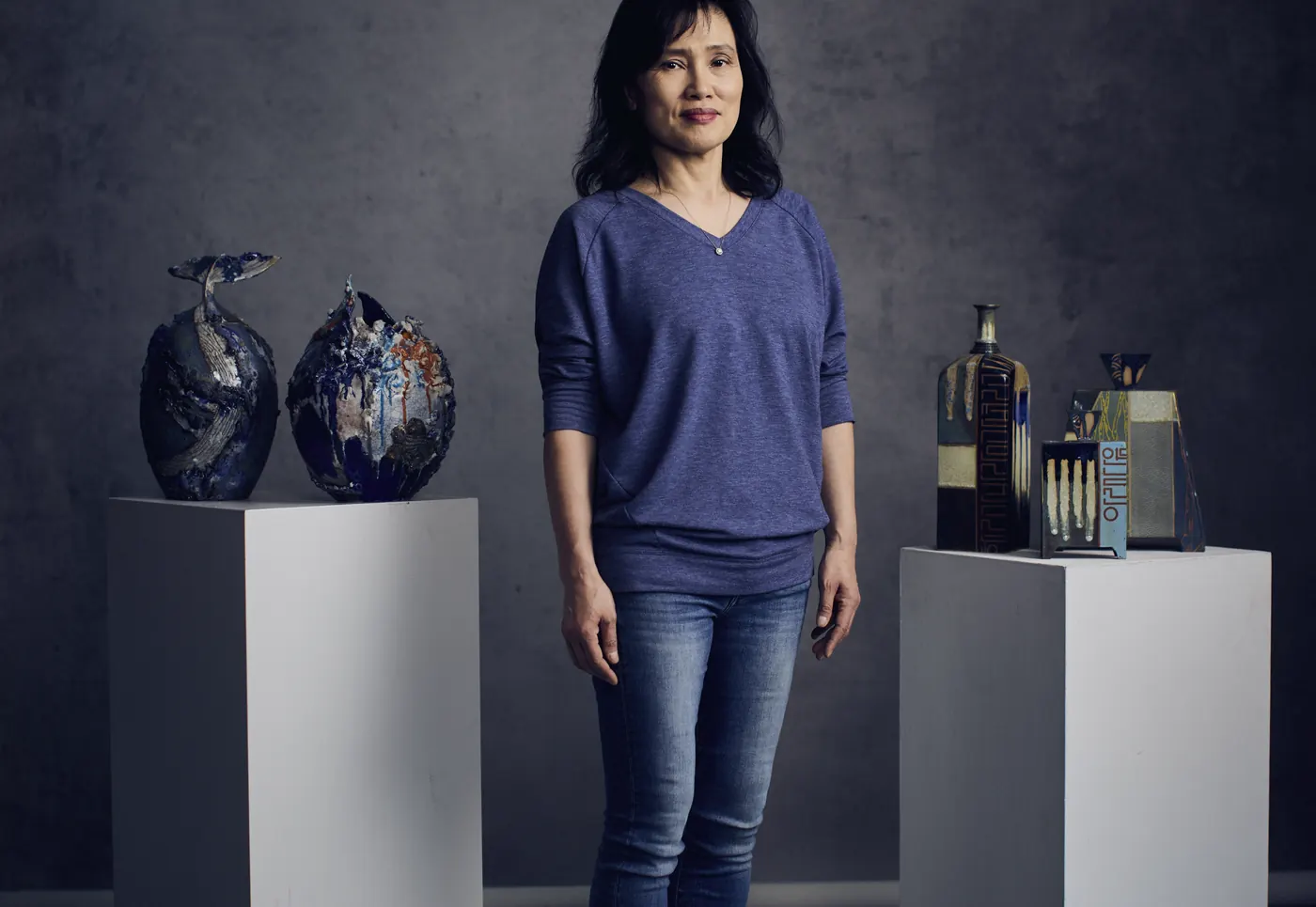
Her work comes in two bodies and they do not look related.
The boxes are built from slabs, flat sheets of clay joined into something architectural: trapezoids and uprights with lids like little roofs. Their surfaces carry old Korean motifs, patterns off the palace walls in Seoul, trim from the roof tiles of Buddhist temples, and more recently Hangul, with the words chosen as much for how they look and sound as for what they say.
The whales are thrown on the wheel. The body is a turned volume; the tail and the lid are cut and added afterwards; then carving, painting, and two firings to 1280°C. They came out of years on the Southern California coast and trips to Hawaii, and out of the bodies of humpbacks — the size of them, the lines, the barnacles.
Galleries tend to want one or the other. She has even entered the two bodies into competitions separately, so that each would be judged on its own terms, which means the outside world has been encouraging her to behave as though she were two people.
For a while she thought she ought to solve it.
I don't want to put Hangul on a whale or add a whale tail to a box simply to prove they belong together. That would feel forced.
Miae KimShe has since stopped trying. Underneath, she thinks, the two are not as separate as they look: both are about carrying something from one place to another, and both use a vessel as a container for memory. And there may be something true to her life in refusing to speak only one language, having moved between countries and between careers, and adapted each time.
Perhaps the more interesting question for me now is no longer how to make the two bodies look connected, but why I felt they needed to look connected in the first place.
Miae KimAn animal that happens to open
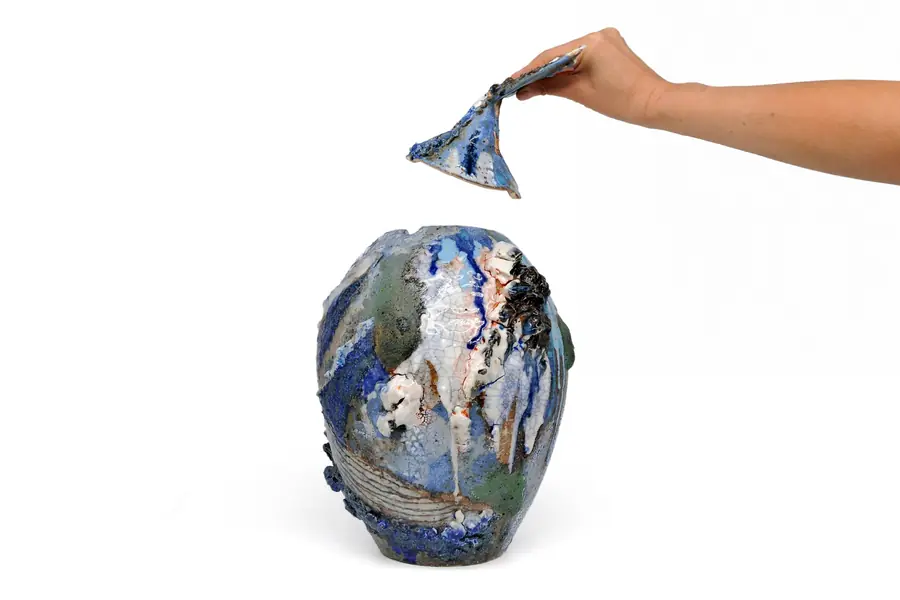
The first whale grew out of the logic of a lidded jar: the vessel came first and the animal arrived as a handle. That has reversed.
Now I would definitely say it is an animal that happens to open.
Miae KimShe thinks about the movement and weight of the animal first, and the opening has to work around it. But she does not want the whale to become a sculpture that could have been made in any material. The rounded body, the slight asymmetry, the sense of volume and pressure all come from throwing, and she wants them kept. The vessel is still under there, and the argument between the two is part of why she is interested.
Her own kiln
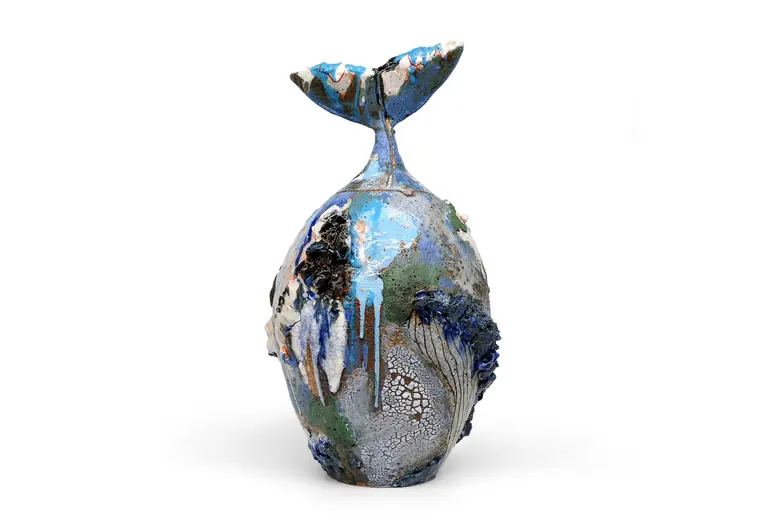
She has one now. She can fire a test, repeat a result, alter it deliberately, fail and try again. The series she calls Fragments of the Ocean had been waiting for exactly that: she wants the whale pieces to stop being vessels with whales on them and become something closer to a piece of ocean floor that happens to contain an animal, which takes layers of slip and glaze she was never going to risk in a kiln she did not control.
What she is wary of is what the freedom might do.
I also don't want freedom to make the work easier or emptier. Looking back, some of the density and patience in the work may have come directly from those restrictions. If that is true, then it is something I would like to keep — but this time by choice rather than necessity.
Miae KimIn 2025 she was selected for Fresh at the British Ceramics Biennial, twenty-five makers chosen from more than three hundred and eighty. Fresh exists to show artists at the start of a practice. She had spent two decades on other people's films before she began this one.
What she says she values, after all those years of a medium in which nothing was ever settled, is the moment the work stops being available to her.
After years of working in a medium where nothing is ever truly final, I like making something that eventually refuses to be changed.
Miae Kim