
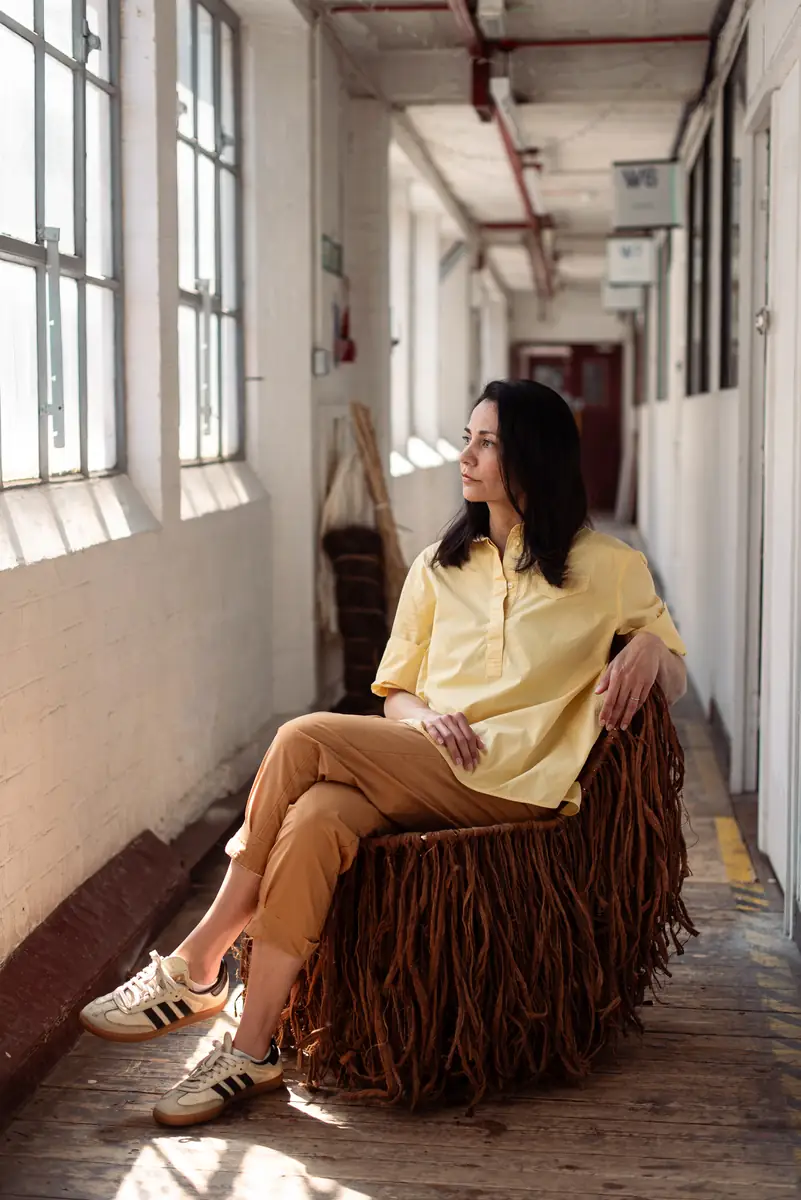
Somewhere in Brazil a teenage girl asked her father a reasonable question: why not simply buy a metal sieve? He had been at work for months on a single one, harvesting and splitting bamboo by hand. His answer was four words long.
It's not the same.
She thought it was stubbornness. It took a death, a career and two decades before she understood it as a position.
The object he refused to replace
A Brazilian peneira is not decorative. Stalks of taquara are split into talas — thin flat strips — and a modest sieve swallows around twenty stalks to yield a hundred and twenty of them. The strips are woven into an overlapping geometric grid and bound tight around a circular wooden rim. The result strains cassava pulp for flour, filters açaí, dries cacao. In a farming household it is not an heirloom; it is equipment.
That equipment is disappearing now, and not slowly. Deforestation has stripped out wild taquara, so the artisans who remain grow it in their own backyards. Young people are not taking it up. And the families who once wove their own have moved, sensibly enough, to cheap industrial plastic mesh.
Which means Angelita Alves's father was not being sentimental. He was refusing, in advance and in four words, the exact substitution that has since hollowed out the craft across a continent.
Three generations, no teachers
Her grandfather made sieves. Her father never formally learned how.
After the grandfather died, he decided to make new ones anyway — studying the old sieves that were left behind, remembering what he had seen, working it out. The first took several months. He cut and prepared the taquara himself before a single strip was woven. “The pattern isn't particularly complex,” his daughter says, “but getting it right requires considerable skill and patience.”
She watched. Quietly, and with the aloofness of a teenager, but she watched.
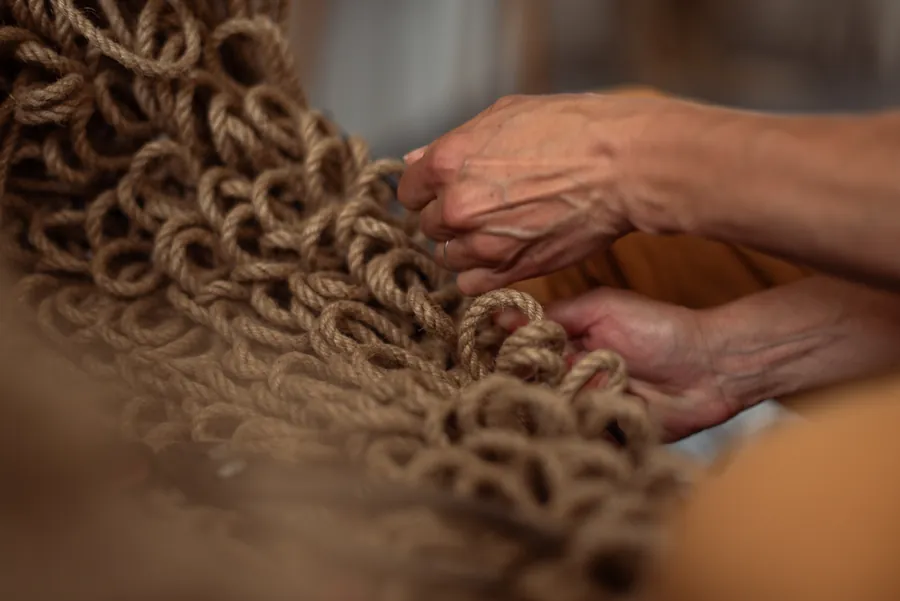
Photograph by Flavia Catena.
Then he died, and making with her hands became a way of reconnecting with her roots and with herself — never having formally learned to weave either. “Perhaps this was, in some way, the same process he had gone through.”
She is direct about what the work is for. “Making is healing for me. It is demanding, physical work that requires patience and immense grit, but the determination I learned from watching my father carries me through.”
Three generations, and not one of them was taught by a living person. Each learned from what the previous one left in the room. What she took was not a technique but a disposition.
It laid one of the foundations for my practice. I figure it out.
Angelita AlvesTwenty years of buildings
The architecture was not a detour from this; it was most of her working life. Alves trained as an architect at the University of Greenwich, the Royal College of Art and Columbia University, then spent over two decades in practice, working with studios led by Bernard Tschumi and Norman Foster — work at civic scale, where a building is drawn for crowds and brought into being by hundreds of hands.
Now she makes a chair. One chair, over three hundred hours, from rope she knots by hand.
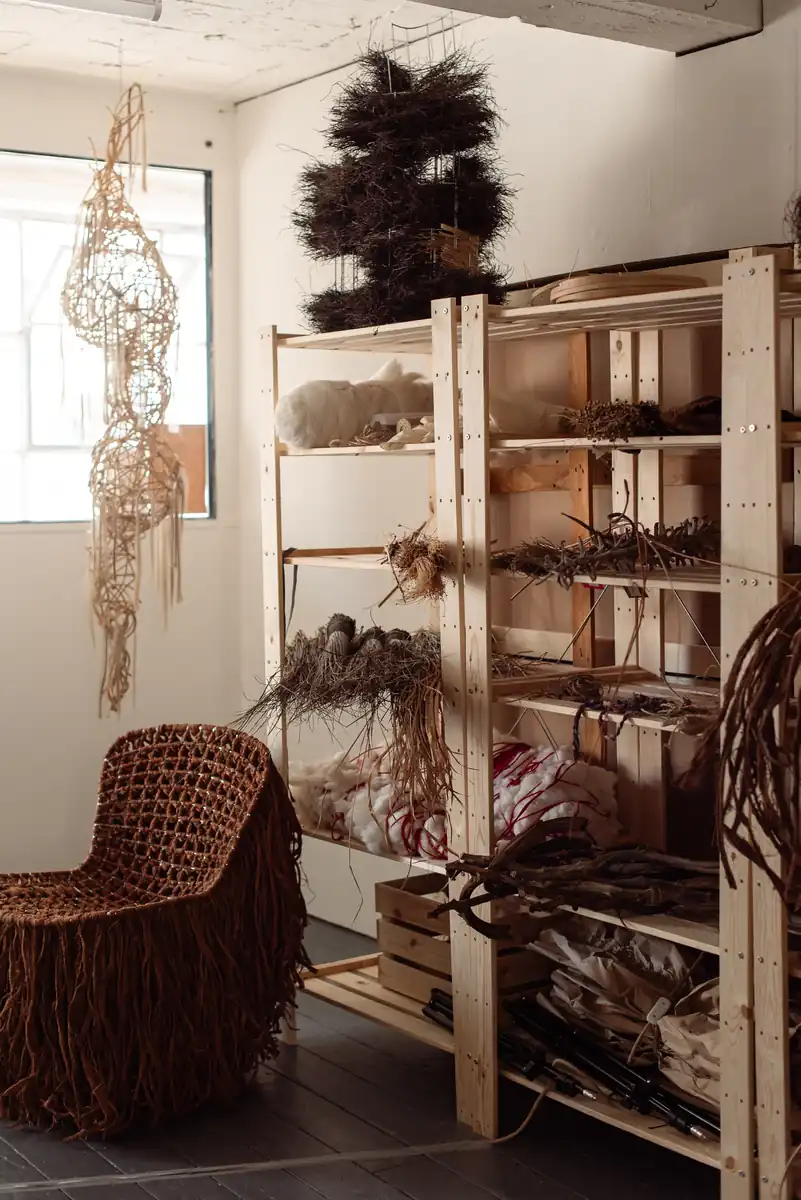
The studio at Cockpit. Photograph by Flavia Catena.
The architecture did not evaporate; it went inwards. She tests fibres for strength, durability and wear, because the seating has to hold a body and not merely represent one. But the scale has inverted completely: from structures that house many people, to an object that holds exactly one person at a time and asks them to stop.
The empty chair
Asked who the absent person in her chairs might be, her answer is immediate.
The absent person is the self.
Angelita AlvesA solitary seat, she says, is an invitation to reconnect with oneself — and “simply sitting in contemplation can become an act of rebellion in today's world, where slowing down is frowned upon.” It is a large claim for a piece of furniture, and it survives contact with the work, because these chairs are physically slow: shaggy with hanging fibre, heavy with hours, impossible to mistake for something mass produced.
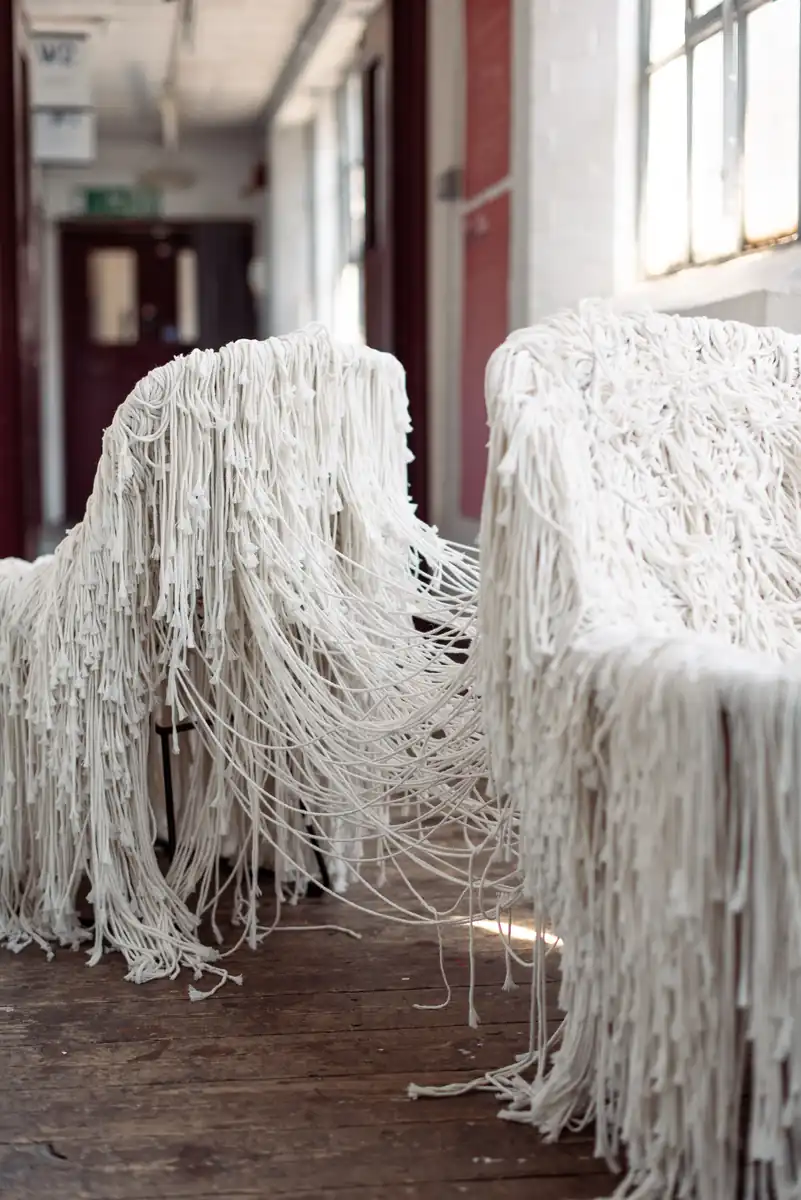
Emaranhamento. Photograph by Flavia Catena.
Then the chairs multiply. In Emaranhamento — entanglement — two are woven physically into each other, and as their positions shift, so does the tension between them and the relationship they imply. The object stops being about solitude and becomes about proximity, dependency, and how much of either a person can stand.
“They hold the body,” she says, “but they can also hold memory, absence and the possibility of encounter.”
Three hundred hours, and the argument with the rope
Ask how long a piece takes and she refuses the premise. “The duration and the technique are completely intertwined. The time a piece takes is not incidental; it is part of the work.”
She describes three stages — concept, design, process. The concept sets what the work has to say; the design has to carry that while surviving the physical demands of the material, which is why the fibres are tested for strength and wear before anything is built. Then comes the part that swallows the months.
Through repetition, I often enter a state of flow where the material and I seem to have a conversation: I relinquish control and let the process take over.
Angelita AlvesIt is an unusual admission from someone trained to specify and control. An architect draws a thing and other people build precisely that. Here the maker gives up the drawing halfway and lets several hundred hours of knotting finish the argument.
What can disappear, and who
Underneath the making is a harder subject. Alves is parda: of mixed Portuguese, African and Indigenous Brazilian descent. Her African ancestors were brought to Brazil through the transatlantic slave trade; her Indigenous ancestors were displaced by colonisation; and, as she puts it plainly, she also has ancestors who were part of that colonial system.
“My heritage contains parts of that history that have been erased, buried or forgotten.”
She thinks about this partly through epigenetic inheritance — the idea that experience leaves marks the body passes on. It is worth being straight about the science: in humans this remains contested, the studies are small, and the strongest objection is that what looks like biological inheritance is more likely transmission by other means. By household. By behaviour. By watching.
Which, in her case, is exactly what happened: she learned by watching a man who had himself learned by studying objects left by a dead man. She has anticipated the objection, and does not accept it entirely. “We can certainly learn by watching,” she says, “but I think there is something deeper” — “an embodied knowledge that is carried through generations, sometimes without language.”
That is a claim the evidence cannot yet settle either way. What is not in dispute is the stranger, plainer fact sitting underneath it: a skill left this family and came back twice, each time through someone nobody taught. Whatever the mechanism, it leads her somewhere the science does not go:
“Basketry and weaving nearly disappeared within my own family lineage, so the possibility of knowledge being lost is as significant to me as the knowledge itself. It raises questions about what is of value, who is of value, what can disappear, and who can disappear.”
That last sentence is the argument of her work. Crafts do not usually vanish because they are defeated; they vanish because families under pressure to assimilate quietly put them down. “The erasure of races and traditions happened within families trying to assimilate and survive, but some vestiges remained.” This magazine has followed a craft that was declared extinct and came back, and a weaver working in twine farmers throw away; the pattern is always the same, and it is never really about technique.
Her answer is not preservation. “Not by preserving it unchanged, but by allowing it to evolve. Transmission is not about simply passing something on intact; it is also about transforming it so that it can continue to live.”
Titles that carry their own genealogy
The thinking runs into language too. She grew up monolingual and now speaks English, French and Italian; when she is making, Portuguese comes to the front. Each one, she says, shows how a culture thinks — another piece of the puzzle.
Phuton Chimera, hanging at jaggedart in London until 3 September, imagines a hybrid plant — a new species formed by the morphosis of two existing ones. Reaching for a name, she went back to the Greek chimera, and found phuton, the Ancient Greek for plant.
“The etymological journey became part of the work itself. The title carries its own genealogy, moving across languages just as the sculpture moves between species.”
Weaving does the same thing physically. “Separate strands retain their individual identities, yet through the act of weaving they become a new structure that could not exist without their coming together.” The metaphor for mixed heritage is exact, which is why she does not find it entirely comfortable — and says so. What she will not accept is that the history gets resolved or erased by being made into an object; it is simply given another form in which it can exist. “Displacement and belonging, loss and resilience coexist and become something else,” she says. “A new kind of beauty comes into being.”
The material changes, but so does the maker.
Angelita AlvesThe proof on the wall
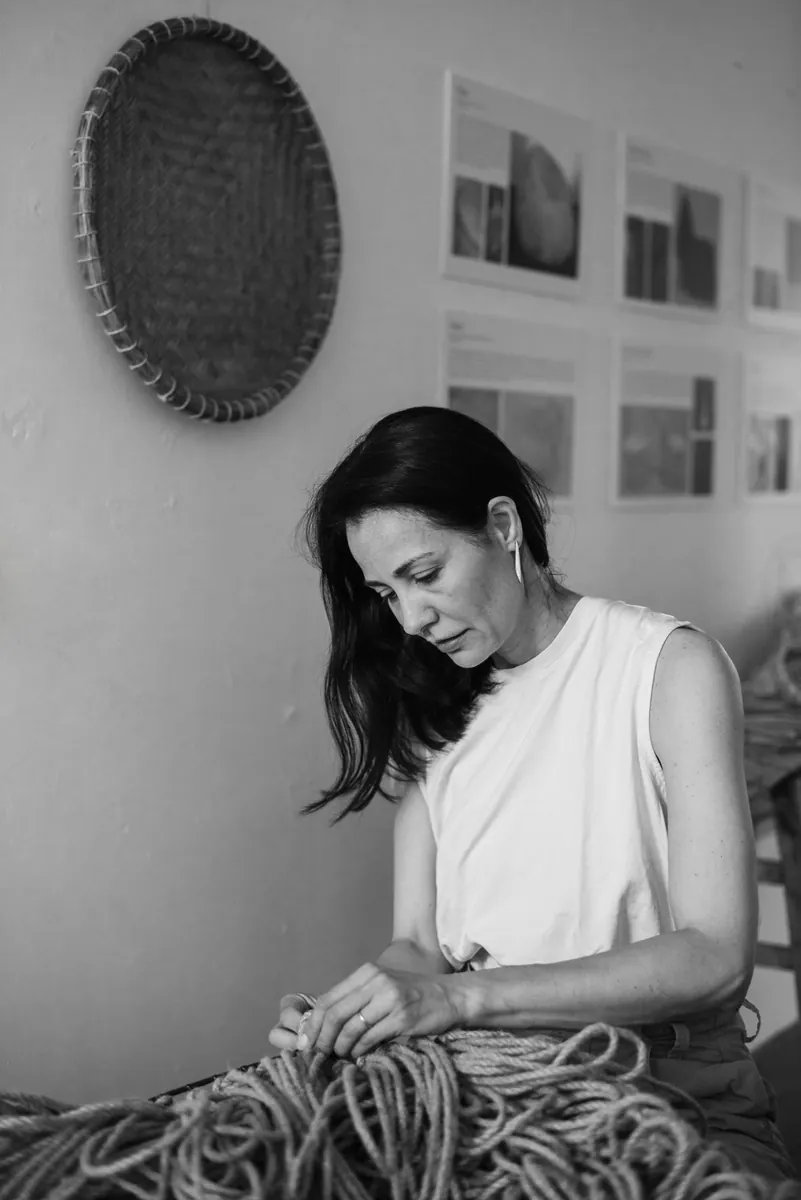
Photograph by Flavia Catena.
There is a black and white photograph of Alves at work, her hands buried in rope.
On the wall behind her hangs a sieve. Her grandfather wove it about seventy years ago. It is the object her father studied, alone, after the man who made it was gone — the thing that taught a craft to someone nobody had taught.
Weaving nearly disappeared from this family. The evidence that it did not is hanging on the wall directly behind the person doing it.
Angelita Alves is showing in Tied and Knotted at jaggedart, London, until 3 September. Photographs by Flavia Catena.