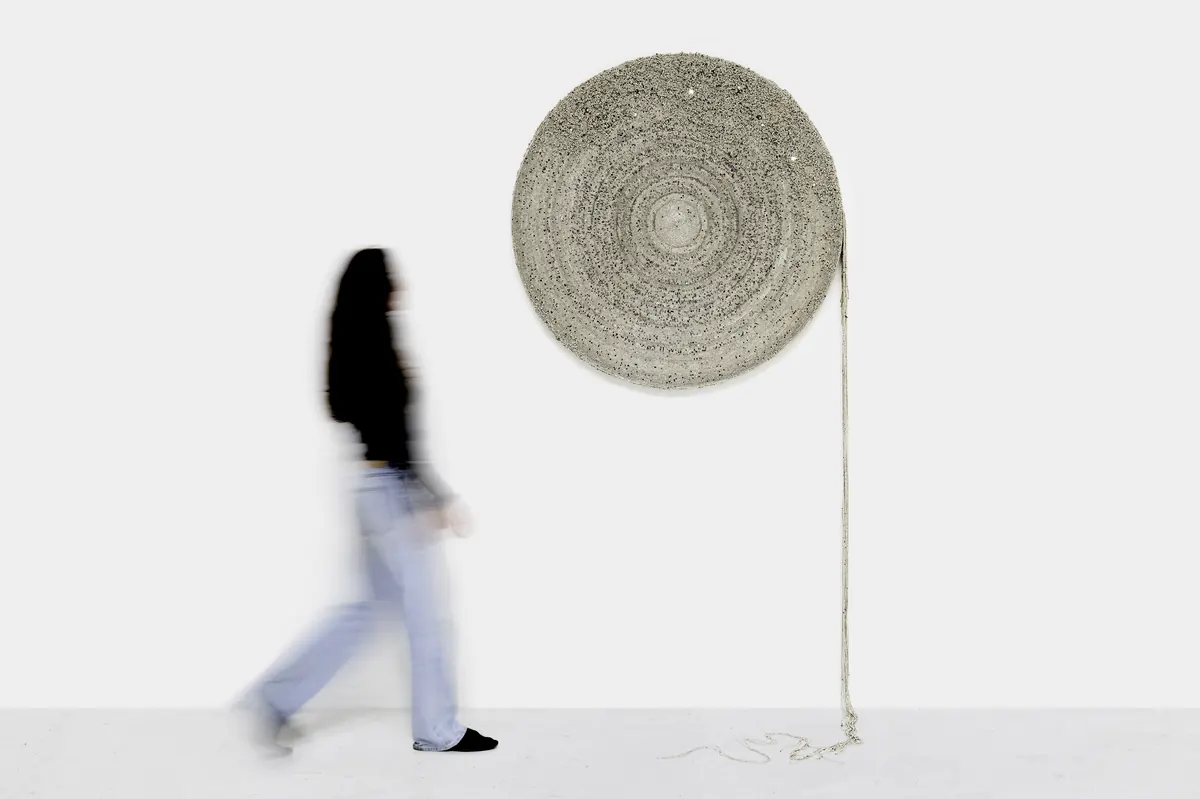
Before code was code it was punched cards on a Jacquard loom. That old kinship is the quiet premise of Video Craft at San Francisco's Museum of Craft and Design: that video, film and early moving-image tools share formal blood with ceramics, textiles and glass. Curators Sarah Mills and Ariel Zaccheo gather nearly twenty artists (28 February–16 August 2026) to make the overlap haptic—light that behaves like thread, loops that behave like weave.
Craft has long been cut out of new-media discourse; the show treats that exclusion as a historical error to reverse. Terms usually reserved for media art—encoding, looping, sampling—are returned to hands and kilns. Kate Nartker's jacquard-woven frame for the animation Green Screen (2025) is emblematic: the loom finishes what the screen only proposes.
When the loop has a grain
The strongest rooms do not illustrate a theory; they make time tactile. Film quilts, woven frames, clay performed for camera, cameraless celluloid processes—artists from Beryl Korot to Jennifer West, Senga Nengudi to Jodie Mack—treat the ephemeral not as dematerialisation but as another craft state. Harnessed light becomes pattern with weight. The disembodied space of video meets media that can still chip, fray or cool.
This magazine's defence of the visible hand finds an ally here. So does our archive on the camera's long material life: two centuries of chemistry before the clean myth of pure signal. Video Craft refuses that myth without nostalgia. Programmes extend the argument: loom-to-screen talks with Korot and Gschwandtner, workshops that keep sewing and speech in the same room.
Against the soft rebrand
The dissenting risk is institutional. Museums can annex craft as texture for tech shows, leaving hierarchy intact—screen as intellect, hand as charm. Mills and Zaccheo push harder by staging pioneers beside digital natives and by insisting on material vocabulary in both directions. Still, any exhibition that flatters both craft traditionalists and media artists will attract the charge of diplomatic breadth. The test is whether a visitor leaves believing a loom can think as rigorously as a codec. The Jacquard already answered; the show only asks you to notice.
Sampling as craft discipline
Compared with Sugimoto's mourning of silver, Video Craft is less elegy than laboratory. Compared with porcelain that remembers fire in Jongjin Park's strata, it argues that the screen, too, can keep a scar—if makers force it through cloth, clay or glass.
In Dogpatch, on Third Street, far from the soft myth of frictionless software, the argument is local and large: San Francisco's tech myth meets a museum that still trusts the hand. The curious luxury is not higher resolution. It is the moment a projection feels woven, and you remember that every image was always made of something.