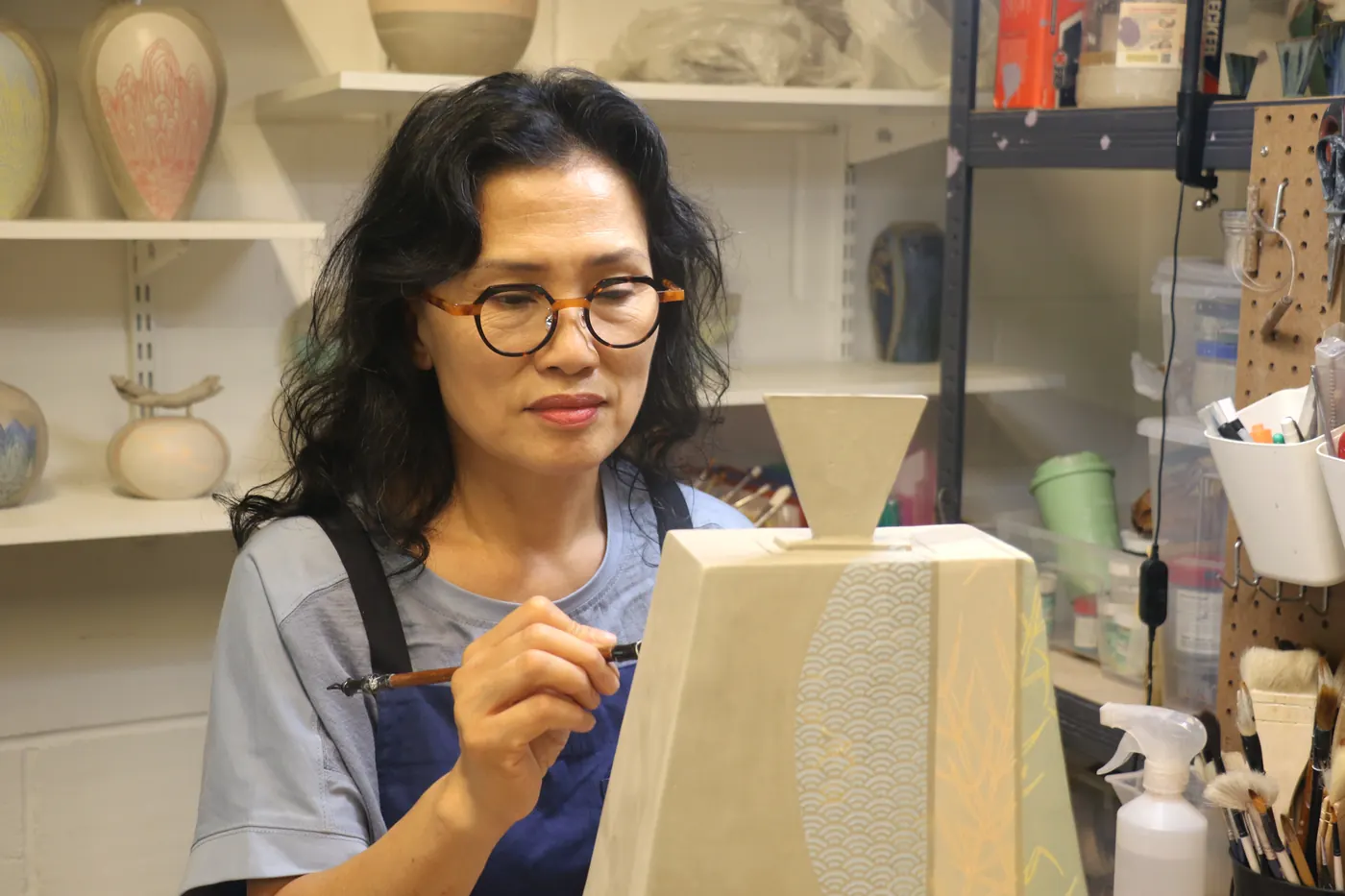
A chemist in Paris taught Morten Løbner Espersen how to calculate a glaze that behaves: reliable, repeatable, the same every time out of the kiln. It is the knowledge the ceramic industry runs on. Espersen took it home and wrote out the opposite — a long list of everything you must never do to a glaze if you want it to come out right.
Then he spent thirty years doing all of it, on purpose, until he could produce the faults exactly.
Half of everything
Anybody can ruin a glaze once. What he is after is the fault that arrives where he wants it, at the depth he wants it, and he pays for it at a rate few crafts would tolerate: by his own accounting, around half of everything he makes does not survive the firing.
That is not a turn of phrase. A vessel is built by hand over days, glazed, fired, glazed again and fired again, and the pieces that reach an exhibition have usually been through the kiln four times or more. Each firing is another chance for the thing to be destroyed, and about half the time it is. He fires more test tiles than finished work — thousands of them — in order to stay a step ahead of a process he has deliberately arranged so that he cannot fully control it. He would rather lose a piece than keep a mediocre surface.
What the loss buys is depth. A single glaze is rarely worth much; two or three layers can be; it is at the third or fourth firing, with more layers on top, that the surface stops behaving like a coating and starts behaving like geology.
Trained to remove noise
He made his first clay vessel in kindergarten. His grandmother kept it, unfired, and he still has it. He spent school afternoons in the ceramics room in Ålborg, and when he reached the school of applied arts in Copenhagen in 1987, most of what he knew about pots came from Greek vessels he had studied in a history class.
Copenhagen was Bauhaus-descended and severe: refine, subtract, remove anything that counts as noise. A year at Duperré in Paris from 1989 taught him the reverse — that sumptuousness could be welcomed and then increased. It was there that the chemist Pierre Le Mâitre taught him to make a glaze do as it is told.
Danish ceramics at the time was brown, and he has said so with affection; but he wanted colour, and thought the tradition had turned its back on the present.
The part that is usually left out
He came back from Paris and could not reproduce his own work.
The frustration went deep enough that he stopped using glaze altogether for a while and made hand-built vessels that borrowed from the stone age. The practice he built later depends on not being able to repeat a result. At the beginning, that was the thing that stopped him.
What restarted him was a game with a rule in it: he lined up the raw materials with the most beautiful names and asked what would happen if he used ten per cent of each. He has worked inside self-imposed rules ever since, on the grounds that without restrictions he gets lost. For one series of Moon Jars the rule was eight glazes, a firing, eight more glazes, a second firing — and if it had not come right by then, it went. He draws under a rule too: a drawing may be altered only by adding more drawing to it, never by rubbing anything out.
A form that cannot hold itself up
Most of what he glazes is a cylinder, built by hand rather than thrown. He has been candid about the absurdity of the choice: a cylinder does not support itself and deforms readily, which makes it a difficult thing to build and a perfect thing to paint on. It is, in effect, flat.
Hand-building is slow, and the slowness is the point — the wall keeps the hesitations of the hands that made it, and gives the glaze a surface to invade. A cylinder also gives the melt nothing to catch on. No shoulder, no swell, nothing to interrupt a glaze running vertically down the side of a pot.
The vessels hold nothing. They are not meant to.
Fear of the empty space
In 2008, while teaching in Gothenburg, he broke one of his own rules on purpose and began making organic, twisted, three-dimensional forms instead. He worked on form alone for about two years. Most of those pieces were never fired at all: he glazed a few, photographed all of them and threw them away, on the grounds that they were a necessary stage but not yet strong enough to stand as work.
By early 2010 it resolved into the series he named Horror Vacui, after the dread of empty space that covers an archaic Greek vase with ornament until no ground is left. His version winds a three-dimensional ornament around a classical vessel so that it half conceals the pot and half announces it. The vessel inside is thrown on the wheel, and thrown precisely, so that the precision argues with the opulence wrapped around it.
Nine jars in a library
The public library at Hillerød, north of Copenhagen, asked him for one or two jars to stand on the floor. He built a scale model of the room — seventy metres long, eight high, six wide — and came back with an objection: the floor was black, it would absorb the light, and pots standing on it would be in the way.
He made nine instead and put them on a shelf that runs the length of the space, two and a half metres up, under a skylight, above head height and out of reach. Being unable to touch them, he argued, might make the surfaces more tactile rather than less.
Each jar took about a hundred and twenty kilos of wet stoneware clay, pressed into a nine-piece mould at four centimetres thick, then coated in a heavily grogged slurry so the glaze would have something to grip. Each carried roughly twenty-five kilos of glaze, brushed on in layers with drying time between them, and was fired repeatedly at 1260°C. For that commission he allowed himself materials he had previously filed under kitsch: lusters, and colours he describes as hysterical, set against sober stoneware tones.
What the kiln decides
His work is titled by number rather than name, the way a laboratory logs a run. The piece shortlisted this year for the LOEWE Foundation Craft Prize — thirty were chosen from more than five thousand entries — is called #2572, a stoneware cylinder glazed three times over, the layers settling into horizontal bands.
He brushes three or more glazes across each other and takes care not to do it evenly, because the unevenness is where the character comes from. Then the door closes, the chemistry takes over, and the man who understands it better than almost anyone waits outside with everybody else.
A firing cannot be undone, any more than one of his drawings can be rubbed out. You can only add another layer and go again, and accept that half of it will not come back.