
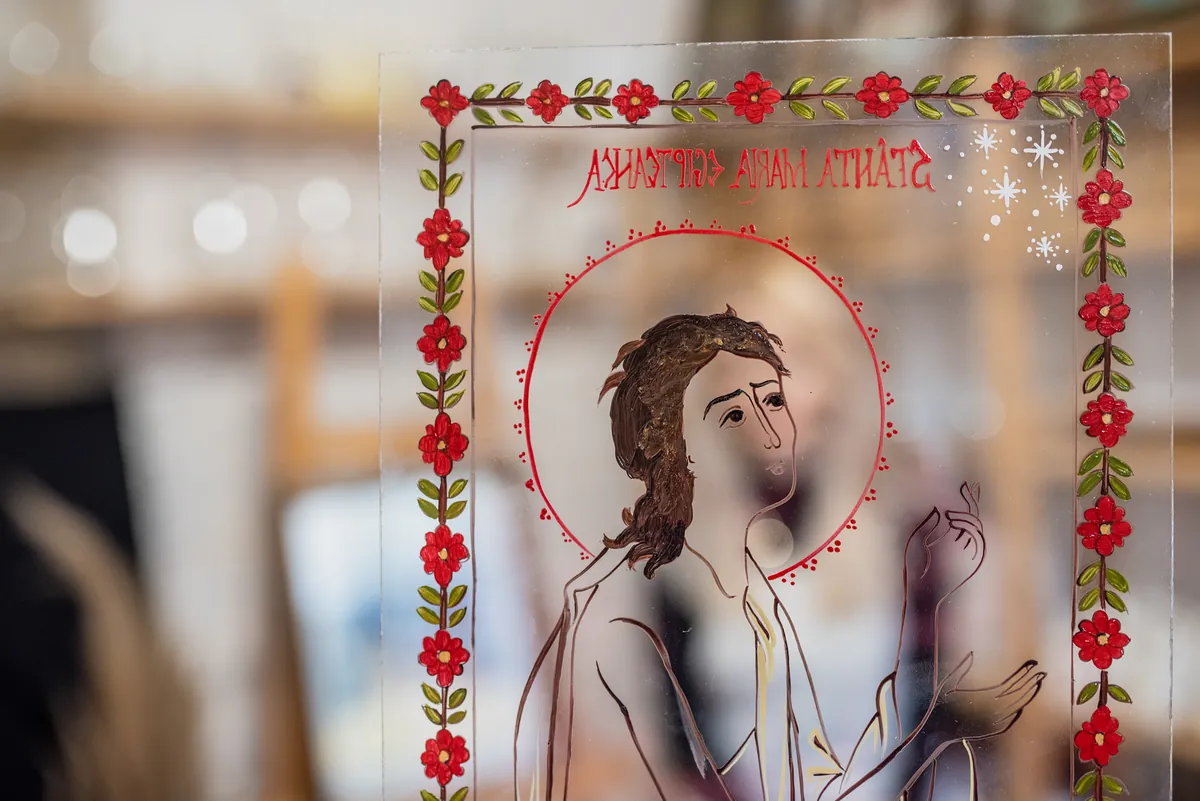
There is a rule in Orthodox iconography that God the Father may not be painted. It is not a matter of taste. Icons are possible at all because of the Incarnation: the Son took a body that could be seen, and therefore drawn. The Father took no flesh, remains invisible, and cannot be pinned inside a human outline. Even the Old Testament visions of an enthroned ancient are read as appearances of the pre-incarnate Son. The Great Council of Moscow banned the images outright in 1666–67, and the Synod of Constantinople repeated the ban in 1776.
Maria Teodorescu was taught this at university, and it is the one thing she says she could not accept.
What was hard for me to accept in the academy was that God is not allowed to be represented because he did not take human form, only his son. And I liked a lot to paint the Holy Trinity where God is also represented as an old man.
Maria TeodorescuThe rule is neither obscure nor recent. What makes it land differently on her is that the house she was trained in had been breaking it for two hundred years.
The disobedient villages
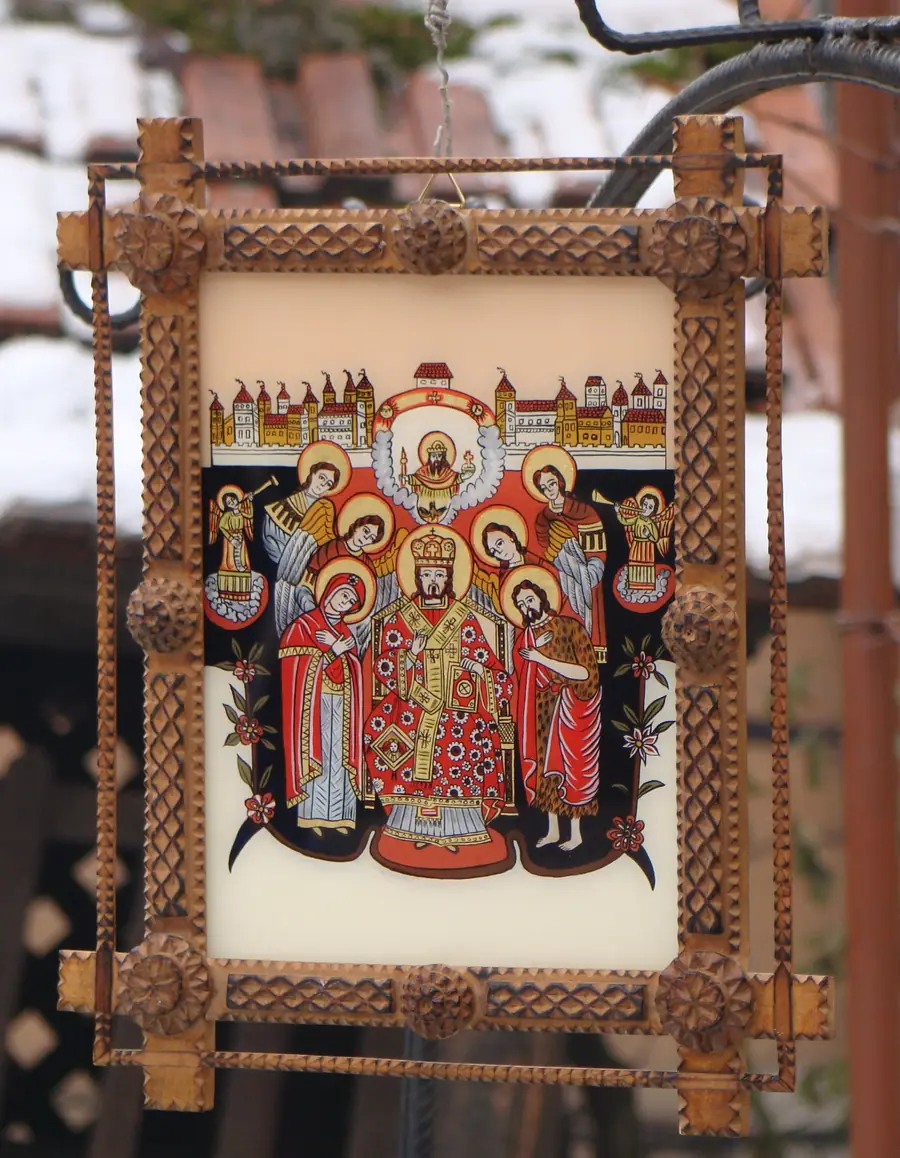
Transylvanian icons on glass are full of things the canon does not allow. At Maierii Albei Iulii the women of the Prodan family turned out Coronations of the Virgin: God the Father as an old man in a red mantle, setting a crown on Mary’s head beside Christ. At Gherla he looks out of the upper corner of a Crucifixion, white-bearded in a cloud with a triangular halo, his hand raised in blessing over the scene below. The subjects had come east with Western devotional prints and Greek-Catholic encouragement, and nobody local was much minded to object.
Nor did the villages stop at that. In Făgăraș they painted an apocryphal legend in which the Devil makes Adam sign away the souls of his descendants for the right to plough the earth, and Elijah steals the contract back. They dressed the soldiers at the Crucifixion in Austro-Hungarian uniform and gave them forked Hungarian moustaches. They moved the Nativity out of its cave and set it in front of a carved wooden peasant gate.
Laz was no different, and the evidence is not archival. It is on the wall of the house where Teodorescu learned. Maria Deac Poenariu painted the Holy Trinity as a single head with three faces inside a gilded triangle, and signed it Laz, 2005. The year before she had painted a Deisis with God the Father looking down out of a cloud at the top, and signed that too. She was in her eighties. Five years after that the Romanian state named her a Living Human Treasure; five years after that she was dead.
Nor was it only her. The national register of classified cultural goods lists a New Testament Trinity and a Coronation of the Virgin by Poienaru painters, and eight Last Judgements across three generations of the family — a composition that does not vary, and that seats the Trinity at the very summit, above Christ the Judge.
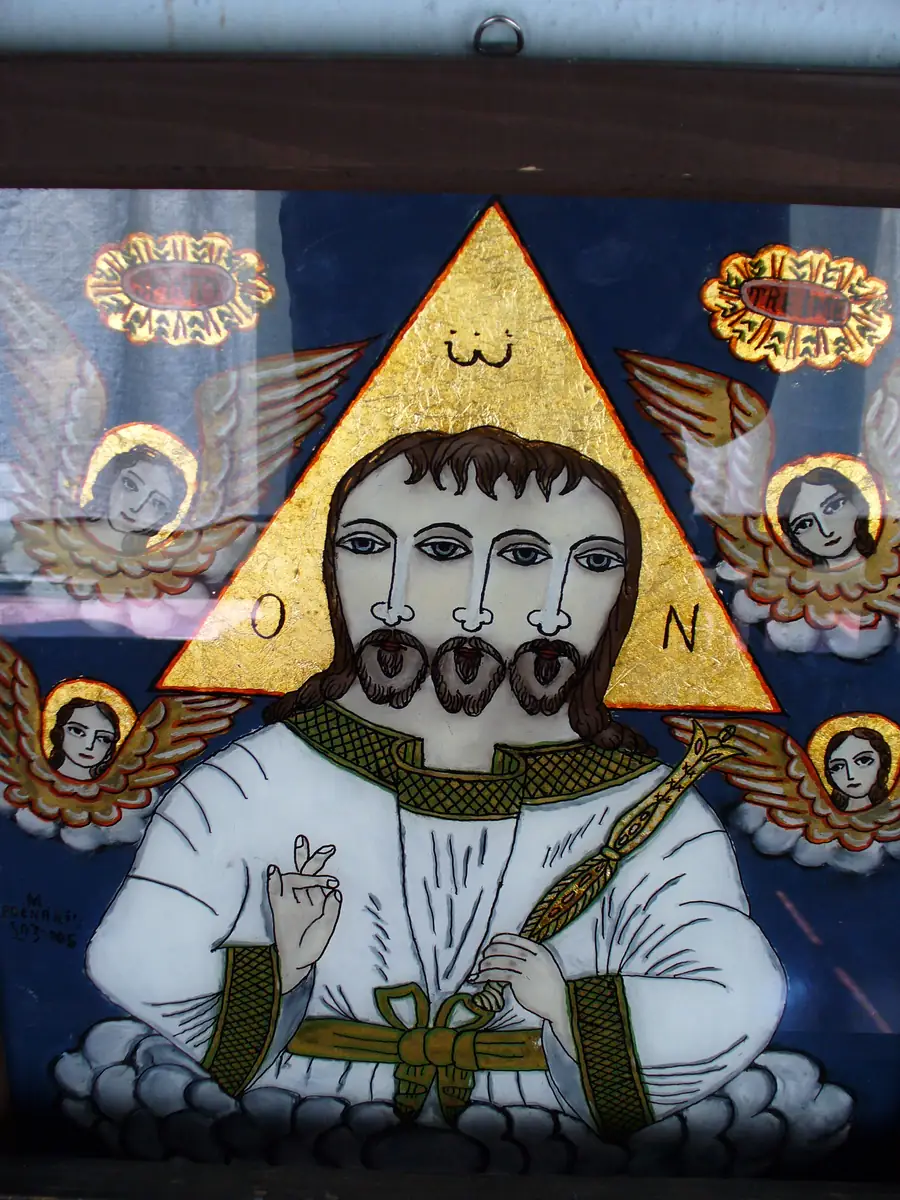
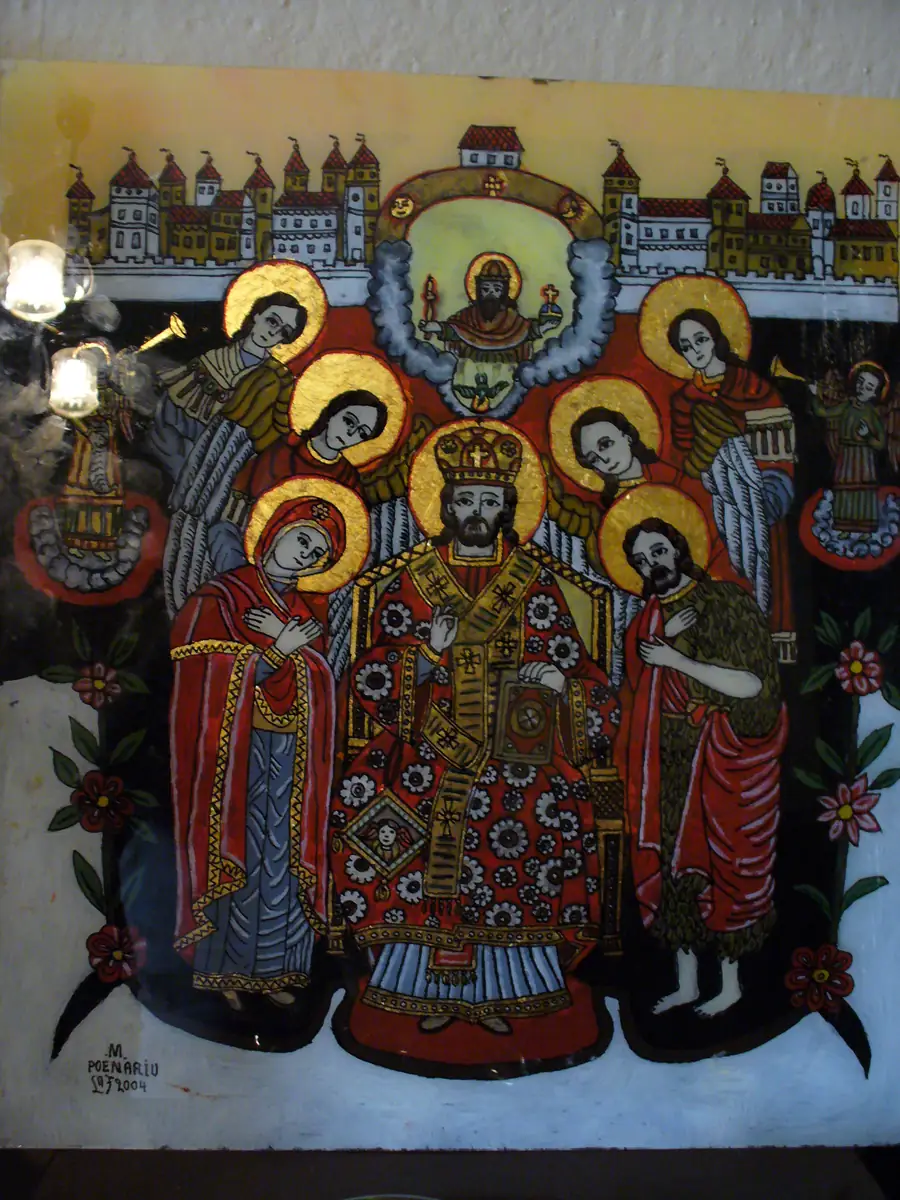
Laz followed the same pattern as the other villages, they inspired from all religions in Transilvania, not only the orthodox. In this way the icons on glass are not only a testament of craftmanship, but also a part of our history.
Maria TeodorescuSo when the Sacred Art section at Babeș-Bolyai in Cluj taught her the canon, it was not only teaching her a rule. It was telling her that the family whose movements her hands had learned — whose last representative the state would name a national treasure — had painted, repeatedly and on the record, what was not allowed.
Where she put the line
She did not choose a side. She worked out where the rule actually binds, which turns out to be a question about use rather than about images.
It is strictly prohibited to make icons outside of the canon if they will be in a church, and the people will pray through them. So even now if I have a commission for church I respect it by the letter.
Maria TeodorescuEverything else — her own collections, private buyers — is free, and she takes the freedom completely: “I can even change the symbolistic of the work or composition parts.” What she will not do is rank the two. “It is a powerful thing to know your work will help somebody connect in church, and on the other hand is a big responsibility when I make something outside the canon.”
The heavier word — responsibility — lands on the free work, not the church work. Inside the canon the rules carry the weight. Outside it, she does.
She came to that position by a route that runs against the usual story of a craftsperson and a canon. She had the freedom first and the discipline second. With her mentor she had been encouraged to put in her own touch; the academy wanted the letter. It took two years before she saw the point of it. Knowing the symbols, she says, means that when you change one, you change it “with substance and meaning, not just something you want different without knowing why”.
What can be handed on
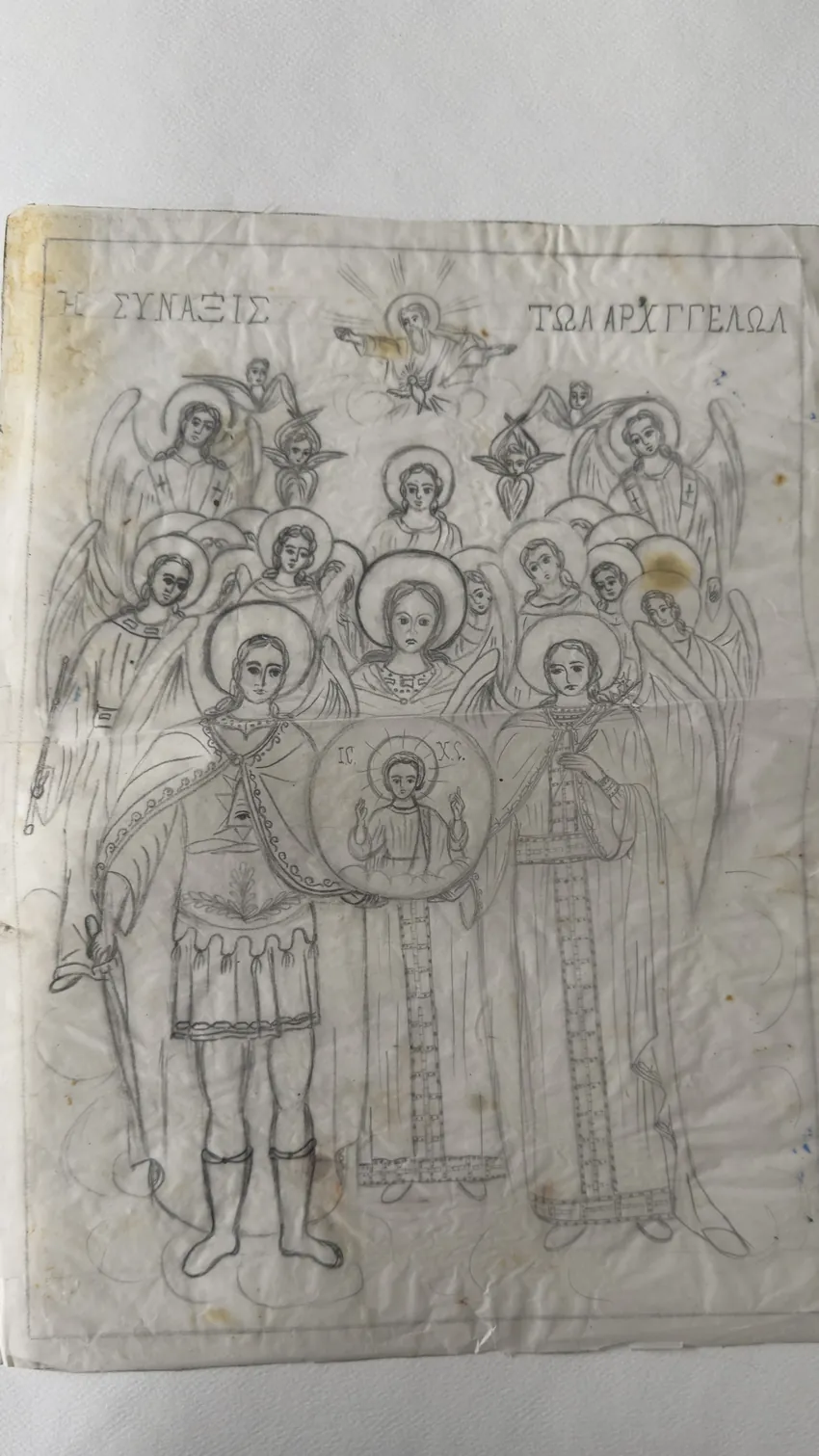
Her teacher was Maria Deac Poenariu, born on the feast of the Annunciation in March 1923, died in April 2015 at ninety-two, in the same house in Laz where she had spent her whole life. The Poenariu family had been painting icons on glass in that village since 1770. Romania’s National Heritage Institute calls her the last representative of the Laz lineage of iconographers.
In 2010 the state named her a Living Human Treasure. The title exists for people who carry something that survives nowhere else but in them, and it has one hard condition: it is personal. It cannot be inherited, transferred, or awarded to a student. When the holder dies it is simply gone.
What could be moved out of that house was the work, and the official record notes that she initiated dozens of generations of young people in iconography, weaving and sewing. One of them was a six-year-old from outside the family, sent there because a kindergarten teacher had told her mother the child could draw, and because the village happened to be where the mother was born and the child spent her summers.
She was not painting icons. For the first years she copied her teacher’s work onto small pieces of glass with a marker — not a brush — so that the hand would learn the movements before it was trusted with paint. What she says this achieved is not technical.
I grew up loving the glass and not being afraid of it — fear being one of the things that makes many artists choose another medium.
Maria TeodorescuA title that dies with one woman; a set of movements that can be given to a child with a felt-tip. Only one of those two things was transferable, and it was not the one the state had a name for.
Backwards, and once only
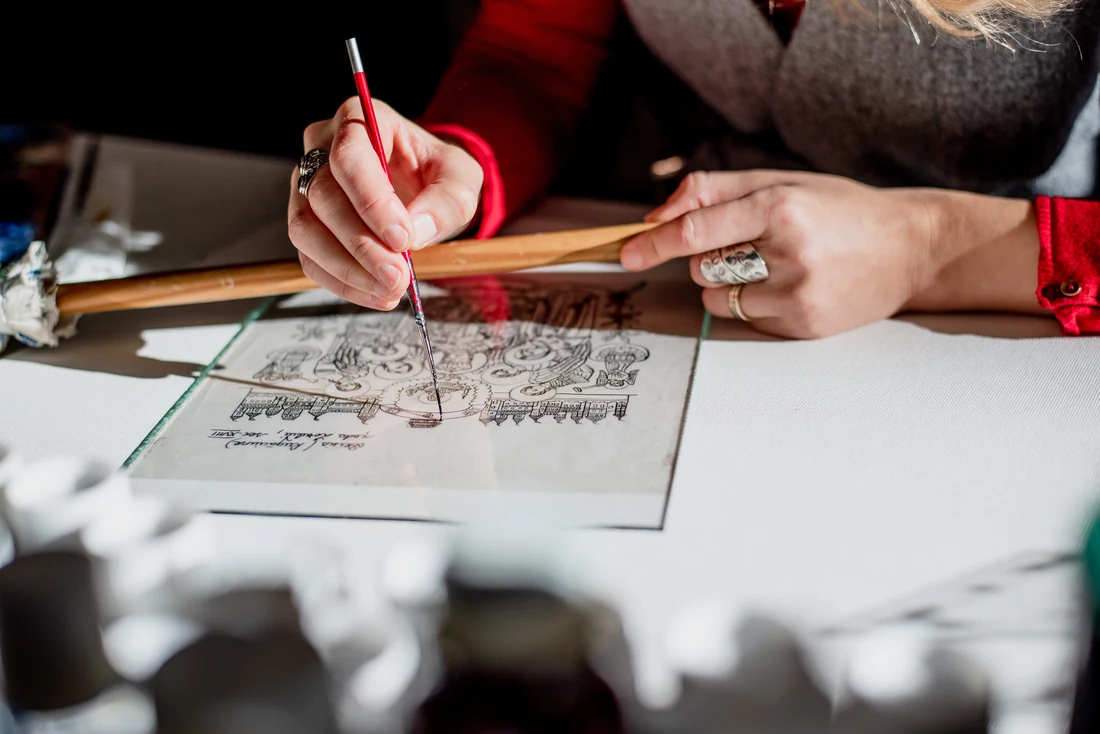
The movements are strange ones to learn. In reverse painting the picture is made on the back of the pane and read through it from the front, so the work arrives in the opposite order to ordinary painting: the outline first, then the faces and details, and the background last of all. Nothing can be corrected, because every line laid down is already underneath everything that will follow.
Teodorescu points out the evidence of how easily this defeats people. On some old icons in museums the lettering runs backwards. It is there because a painter forgot, for a moment, that the image had to be reversed.
Glass punishes twice. It breaks, and it will not hold paint. The surface is non-porous, so there is nothing for a pigment to key into; oil colour on glass sits on top of the pane rather than in it, gripped by very little. In the long run it is famously impermanent. Every icon painted in the traditional way is a picture with a slow appointment to keep.
Fire
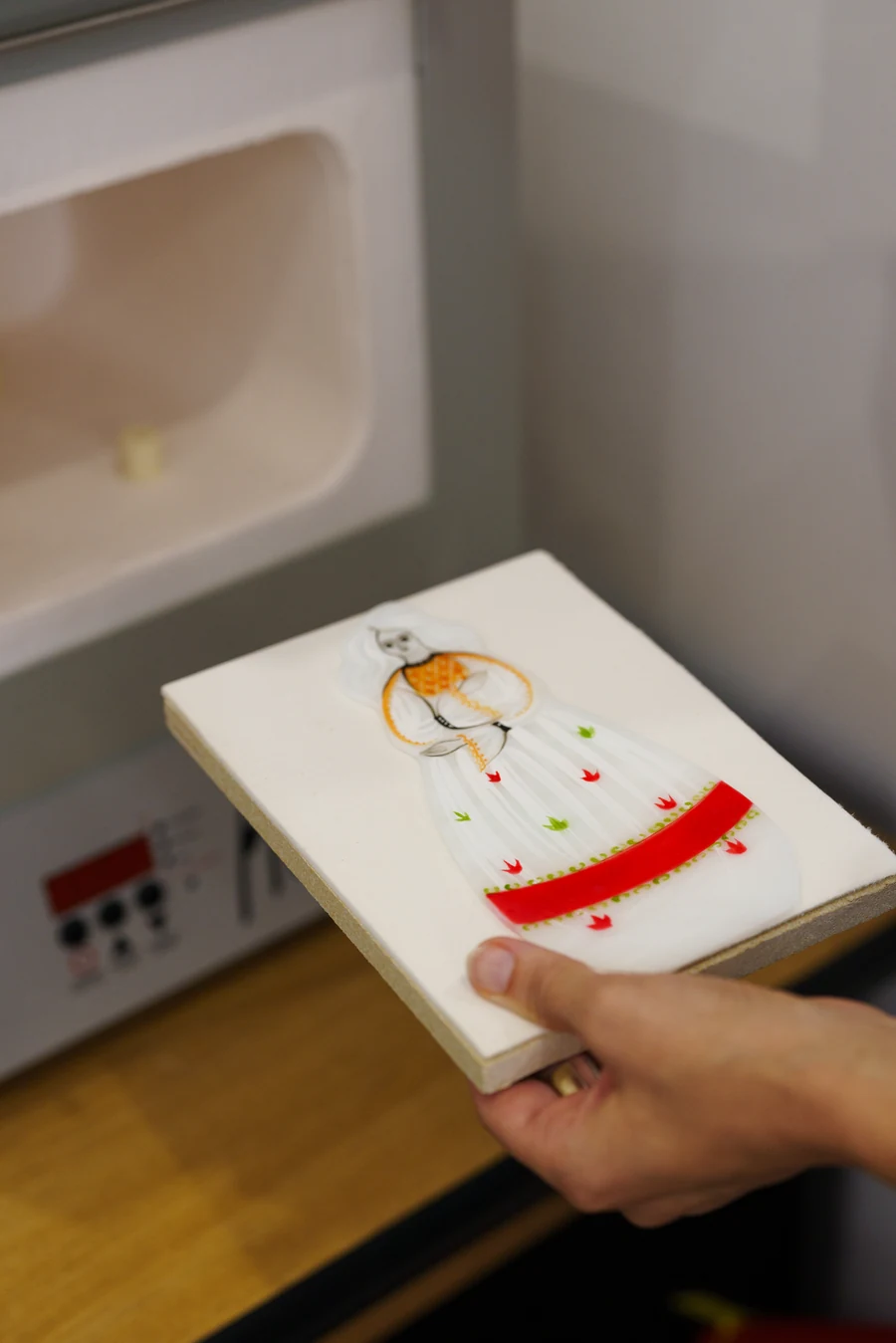
In June this year she stopped accepting that appointment. “It was a natural evolution for me,” she says, “and somehow a complete cycle to end the work through fire.” On her own site she calls the same change deliberate and radical. Both are true: it felt like a continuation and it was a break.
The new work is on Murano glass, painted in vitreous enamel and fired. Enamel is finely ground glass mixed with pigment; in the kiln it does not dry on the surface but melts and diffuses into the pane, so the decoration becomes a glass-to-glass bond, chemically part of the object. Her word for it is irreversible. The pigments are metal oxides sealed inside fused glass, out of reach of light, damp and solvents. They will hold for centuries.
She has moved, in other words, from a technique that must eventually fail to one that essentially cannot. Fired enamel is not invulnerable — it is glass, so under a blow it does not peel, it shatters; and if enamel and pane expand at different rates the whole thing can craze weeks later without warning. But it does not let go slowly. It either lasts or it breaks.
Until now, she writes, glass had been for her a transparent canvas. Now it becomes active matter, a carrier of history.
Why she still opens the tin
She has not stopped painting the old way, and the fragility, she says, has its beauty. But the actual reason she gives for keeping a technique she knows will fail has nothing to do with preservation, heritage or duty.
It helps me reconnect with my childhood and the people I learned this craft from — it is like we make together the same repetitive movements. Even when I open the boiled linseed oil it takes me back there.
Maria TeodorescuLinseed oil is the binder that will not, in the end, hold. It is also the smell of a room in Laz and of a woman who has been dead for eleven years. She keeps the impermanent technique because it is the one that puts her hands back inside somebody else’s.
The corner of the studio
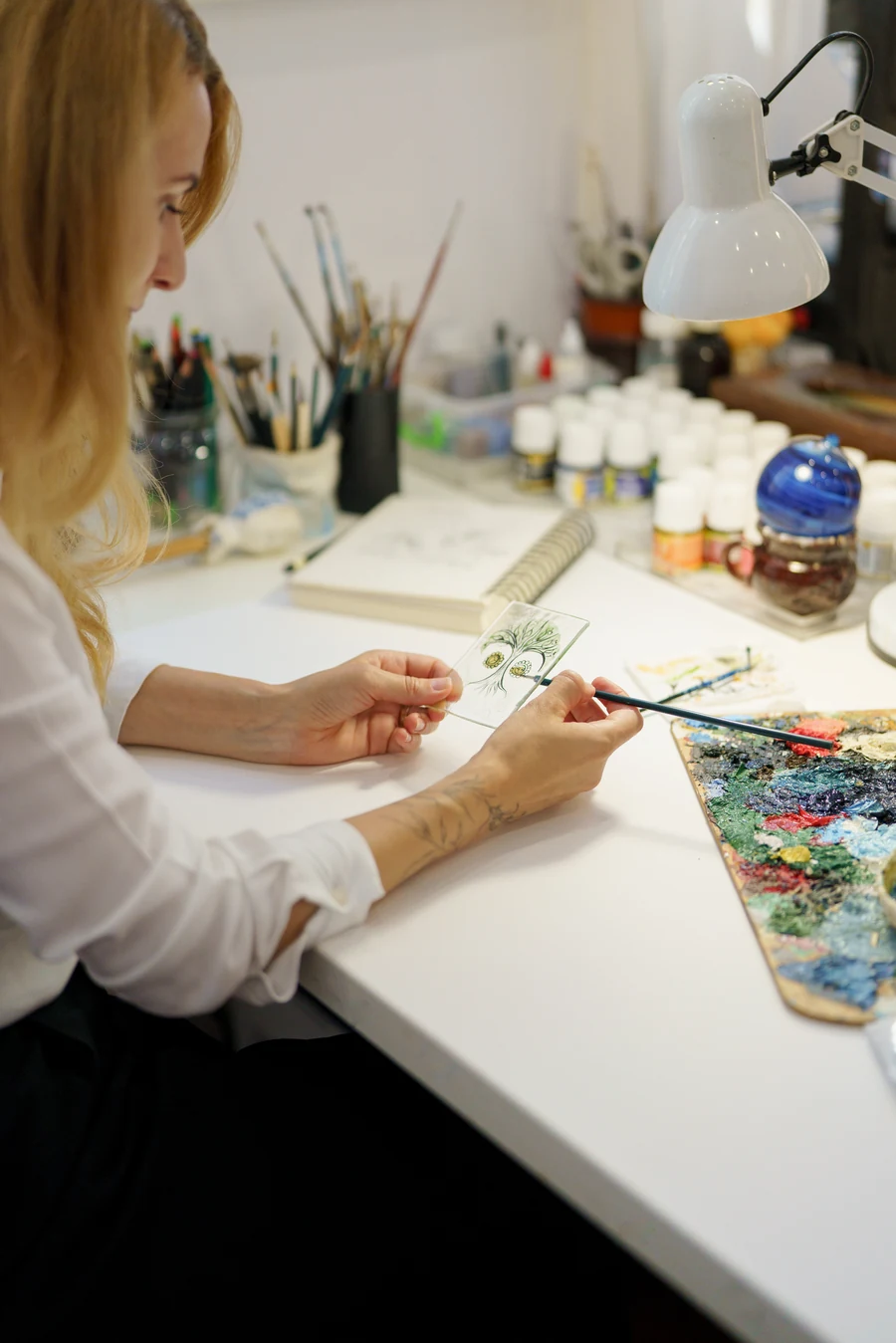
In reverse painting a mistake cannot be undone, and a kiln can take a whole firing at once. What she has actually lost is glass: broken by accident, broken in delivery, lost in failed tests. She has made an arrangement with it.
I even began collecting all these failures. It brings me peace to see them in a corner of the studio, reminding me of all the hard work I did before all the finished polished pieces.
Maria TeodorescuWhat is hard, she says, is not the breakage but that endangered crafts are not given the priority they deserve. And then, immediately, without being invited to balance it: that after all these years she still cannot wait to get to the studio in the morning, and that this is more than enough.
Most people who buy from her, she says plainly, buy for decoration or to collect. She does not treat that as a defeat, and her reasoning is the same one she applies to the canon — it depends what the object is for. If they are choosing her hand rather than the subject, that is an opening: a way to take the tradition and put it in front of people who would never have gone looking for it.
Three authorities decide what an icon may be. The canon says what can be shown; the Church says which pictures may be prayed through; the material decides how long any of it survives. Teodorescu has quietly taken her own position on all three — painting the forbidden old man as her teachers did, putting the heavier responsibility outside the church rather than inside it, and walking away from a technique that fails. And then, having settled all that, she goes on opening a tin of linseed oil, because it is the only way back into a room where a woman who could not leave anyone her title left a child a marker and a piece of glass.
Photographs by Iosana Draci, Diana Jula and Daniel Bodea, courtesy of Maria Teodorescu.
Related: the restorer who signs his repairs so the next one can find them, and a craft that read its own obituary.