
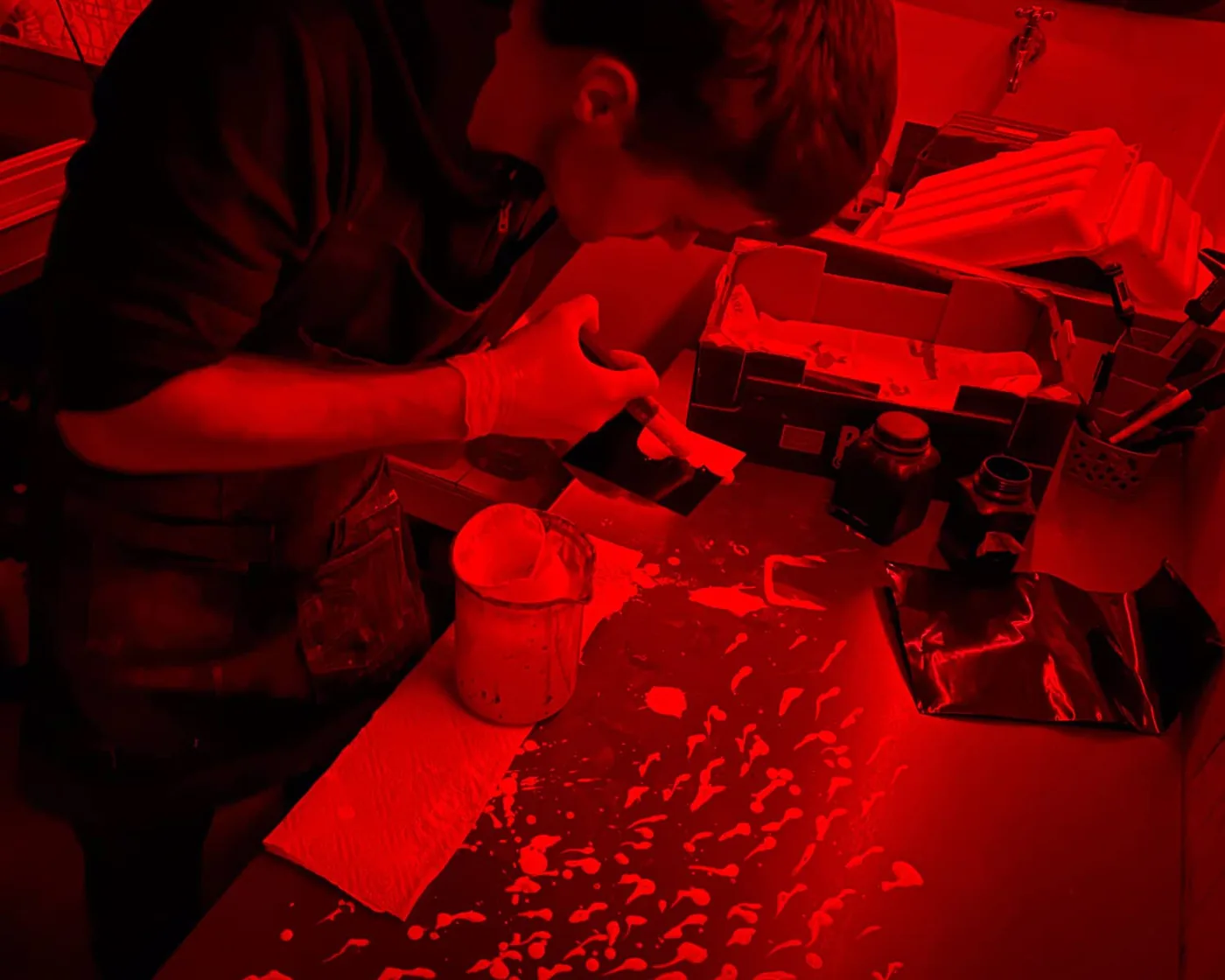
In April, in a workshop in Slovenia, light went through a layer of dyed potato starch, ten to fifteen microns a grain, and landed on an emulsion sensitive to the whole visible spectrum, and for the first time the two layers agreed with each other. Nejc Urankar had a complete Autochrome plate, screen and emulsion of his own making. It had taken nine years, and it came out as a negative.
An Autochrome is by definition a positive, a transparency held up to the light. The Lumière brothers patented it in 1903 and sold it from 1907, and for two decades it was how colour photography was done. A negative Autochrome is, strictly speaking, the wrong object.
Perhaps the negative is neither a failed copy nor yet a new process. It’s evidence.
Nejc UrankarThe prerequisite that ate the decade
In 2017 Urankar was a student who wanted to make an Autochrome. The reasoning was simple: to make one you need a panchromatic emulsion, so you need to understand how photographic emulsion works, so you learn to make emulsion. That sentence compresses well. It cost him the next nine years.
Making an emulsion once is one problem. Making it reliably is another. Making thousands of plates that behave the same way is another again, and behind that stand glass, coating, drying, packaging, sensitometry, machinery, chemistry, customers and shipping. At some point the preparation had become the work, and the work had become a factory.
The student version of me imagined the photograph. He didn’t imagine the nine years of infrastructure required to make the photograph possible.
Nejc UrankarWhat he built in the meantime was Zebra Dry Plates, which sells coated glass to photographers who cannot coat their own. Almost everyone who works with film is a user of a surface somebody else manufactured. Urankar makes the surface. A photographer shooting his plates is holding an image made on a material with a maker’s name attached, which is ordinary in paper and unheard of in film.
What the hand knew
For seven years he coated by hand: more than a hundred thousand plates, every size, three full days a week pouring emulsion and drying plates and trying to keep up with the orders. At the start it was a few hundred plates a month. By the end, as he puts it, he had essentially become the machine.
Then he built a machine to do it instead, and the machine had to be taught. Teaching it meant finding out what the hand had been doing, which turned out not to be a movement at all.
The hardest thing to translate was not a particular movement of the wrist. It was correction. When you coat enough plates by hand, you are never really repeating exactly the same movement. You are continuously compensating without consciously describing what you are compensating for. The emulsion feels slightly different today. The glass is a different temperature. The bead is moving too quickly on one side. You tilted a fraction too far. You see the coating front behaving differently and your hand changes what it is doing before you have formulated the problem in words. That is the knowledge hidden in the wrist.
Nejc UrankarA machine cannot compensate like that unless somebody first names what the compensation was for. So one apparently simple act — coat the plate — had to come apart into viscosity, temperature, volume, acceleration, velocity, angle and timing, and then into the ways those interact. And at the end of it the interesting thing was not that the machine had learned to compensate. It was that the reasons for compensating could be removed.
I had spent years training myself to compensate for an imperfect process. With the machine, instead of getting better at compensating, I could start removing the reasons compensation was necessary.
Nejc UrankarTwo tonnes
The machine coats by laminar flow, the method used in modern film manufacture: a smooth non-turbulent sheet of emulsion falling onto the moving plate, with control over temperature, speed, curtain thickness and flow. It needs fifteen litres of emulsion circulating to work at all. A whole room had to become a drying chamber, with hundreds of evenly spaced shelves. The first two runs failed on microscopic bubbles. The third produced flawless plates, in November 2025. By his account they are the first machine-coated dry plates in more than half a century: Ilford and Kodak shut their lines in the 1970s, and the machines were dismantled and never rebuilt. Everyone who has kept the medium alive since has coated by hand.
At one point the layer came out so thin that holding a plate from underneath left faint impressions of a palm, printed by the warmth of a hand.
The machine is in some ways a record of everything hand coating taught me.
Nejc Urankar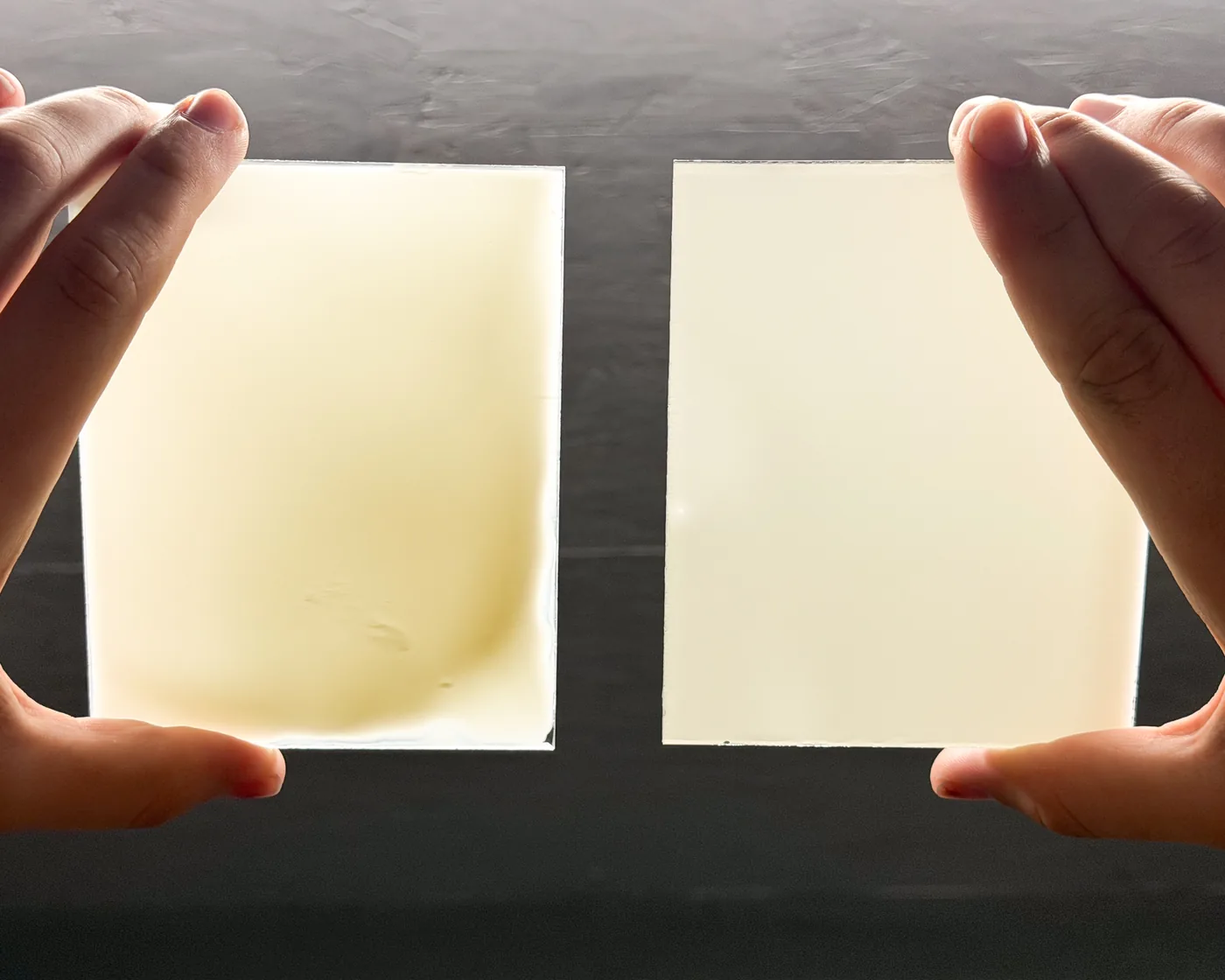
A bubble is not a signature
The hand-poured plate is exactly what a good many people think they are buying. A machine plate is thinner, more even, free of bubbles and dust: better by every measurable standard, and for that reason suspect.
A bubble isn’t my signature. Dust isn’t craftsmanship. An uneven coating isn’t evidence that somebody cared more.
Nejc UrankarHis argument is that the coating is not the finished object. It is the material from which somebody else will make the finished object, and an irregularity in a photograph ought to come from the photographer, the lens, the subject, the development or from chance — not from the fact that his wrist moved differently on plate number 38,412. The ideal plate disappears as a manufactured thing and lets the photographer think about the photograph.
If the highest expression of craftsmanship is deliberately preserving defects that you already know how to remove, then I don’t find that definition of craftsmanship very useful.
Nejc UrankarHe is also careful to defend the machine against the obvious charge. He did not build two tonnes of equipment because he never wanted to pour another plate; he still enjoys hand coating. He built it because after tens of thousands of plates he no longer thought variability was something a customer should pay for merely as proof that a human had been involved.
The flaws that survive are now a line in the price list. Plates with local or cosmetic defects are sold cheaper as Test Plates, on the reasoning that throwing away a plate somebody could make a good picture with is hard to justify when the buyer knows exactly what they are getting. Defects that make exposure unpredictable are not a cheaper product; they are waste.
Photography is very good at becoming nostalgic for technical limitations approximately five minutes after we solve them. Maybe in twenty years I’ll have to build a machine that accurately reproduces the defects of my hand-coated plates.
Nejc UrankarISO 2
The plates run at about ISO 2, which is seven and a half stops slower than a four-hundred-speed film. That is not simply a matter of long exposures. It decides what can be photographed at all.
ISO 2 removes movement from your vocabulary very quickly.
Nejc UrankarFast action goes. Spontaneous gesture goes. Street photography of the usual kind goes, and so does anything whose decisive moment lasts a fraction of a second, because the subject will have left long before the exposure has finished. Even wind becomes a decision.
It also changes the agreement with whoever is in front of the camera, because they have to consent to the duration.
You cannot steal the expression in quite the same way. The person has to participate in making the photograph. They have to remain there. Even when they try to remain perfectly still, they don’t, so time becomes visible in a face.
Nejc UrankarHe does not think slowness should be fetishised, and says that not every limitation is profound merely because it is old. The distinction he keeps is between a constraint that creates a different photographic language and a defect that gets in the way.
Particle engineering, with potatoes
An Autochrome makes colour with a screen of dyed starch grains in three colours, spread across the glass, filled in with carbon black, flattened, and covered with a panchromatic emulsion. The same grains that filter the light going in colour the image coming out. Each grain has to fall within a narrow size range, roughly ten to fifteen microns.
“Potato starch” makes Autochrome sound charmingly domestic. The reality is closer to particle engineering.
Nejc UrankarGetting to that range means separating and grading an enormous population of particles, not finding a magical variety of microscopic potato. The grains are then divided, dyed, recombined in controlled proportions and distributed as densely and randomly as possible; the gaps are dealt with; the layer is flattened; and all of it has to stay compatible with the emulsion above.
Before you have made any silver image at all, you have already manufactured a microscopic colour filter out of potatoes.
Nejc Urankar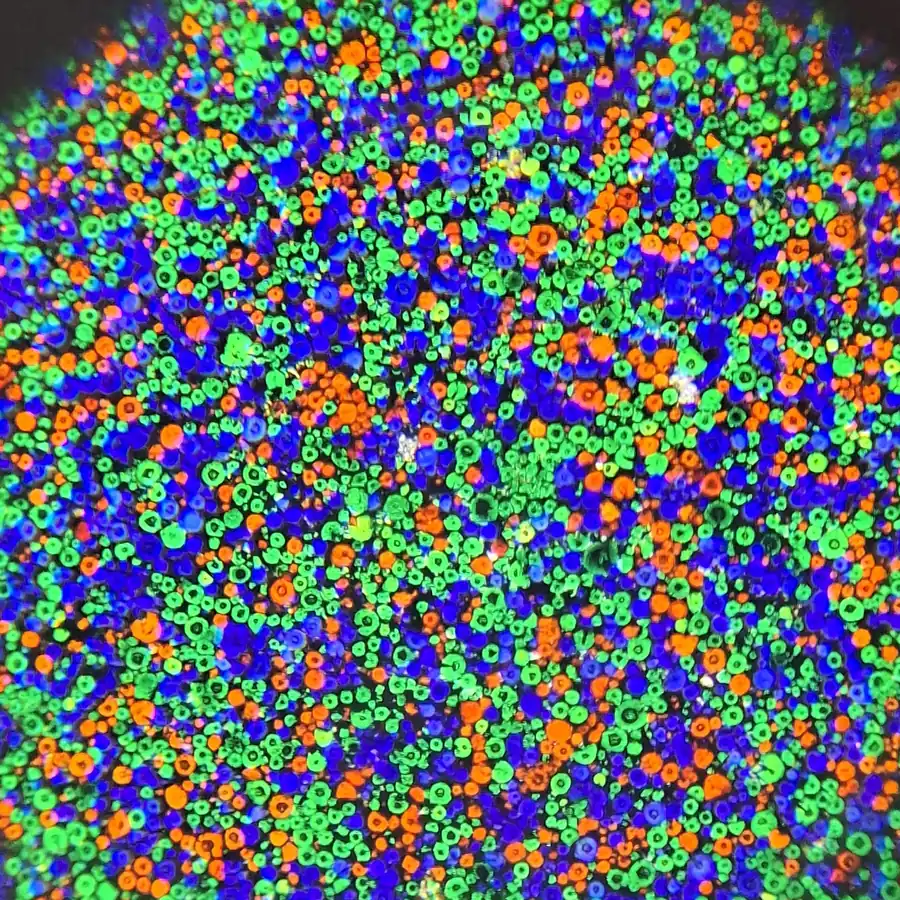
The screen and the emulsion cannot be designed separately. The spectral sensitivity of the emulsion decides how the image responds to the filter layer, so the ratio of red, green and blue particles has to be tuned to the emulsion’s response curve. Shift the balance and colour reproduction goes unstable: too much of one component and a cast takes over, too little and part of the spectrum drops away. A raw material that behaves differently can propagate all the way into the final image, although, as he puts it, whether the potato gets the blame personally is another question.
Coating in the dark
A panchromatic emulsion is sensitive to everything, which means no safelight of any kind. The most beautiful colour process ever invented has to be poured in absolute darkness.
Under a dim safelight there is still reassurance: the coating front can be inspected, the emulsion watched as it moves, a corner checked. All of that goes.
So you replace sight with repetition and physical information. You know the amount of emulsion you’ve dispensed. You know the position and angle of the plate. You feel how the liquid moves through the plate and through your hands. Timing becomes much more important. You learn not to interrupt a movement simply because you can’t visually confirm it.
Nejc UrankarIn a strange way, making panchromatic plates manually asks you to trust everything you learned while you could see. And then you switch the lights on later and discover whether your confidence was justified.
Nejc UrankarThis is the bottleneck. For reverse processing to work, development has to reach all the way through the emulsion to the glass; any unexposed silver left underneath turns up in the positive and makes it dense and muddy, and that density blocks the light that is supposed to illuminate the colour screen. A coating that would be perfectly acceptable for a negative can fail completely here. Thinner and less contrasty emulsions work better, which means coating thinner still, by hand, blind.
The intended answers are practical. Dust the colour screen onto large plates and send them through the machine, which does not become less accurate when somebody turns the lights off. And, in the meantime, infrared goggles: a way of literally seeing in the dark, for a process patented in 1903.
Evidence
In May the first reverse-processed Zebra Autochromes came out of the tank: not scans, not digitally inverted negatives, but direct-view colour transparencies, exposed in the Czech Republic at ISO 2 for a quarter of a second at f/11. They have the thing the Lumières sold — soft light, luminous colour, a depth that is difficult to fake.
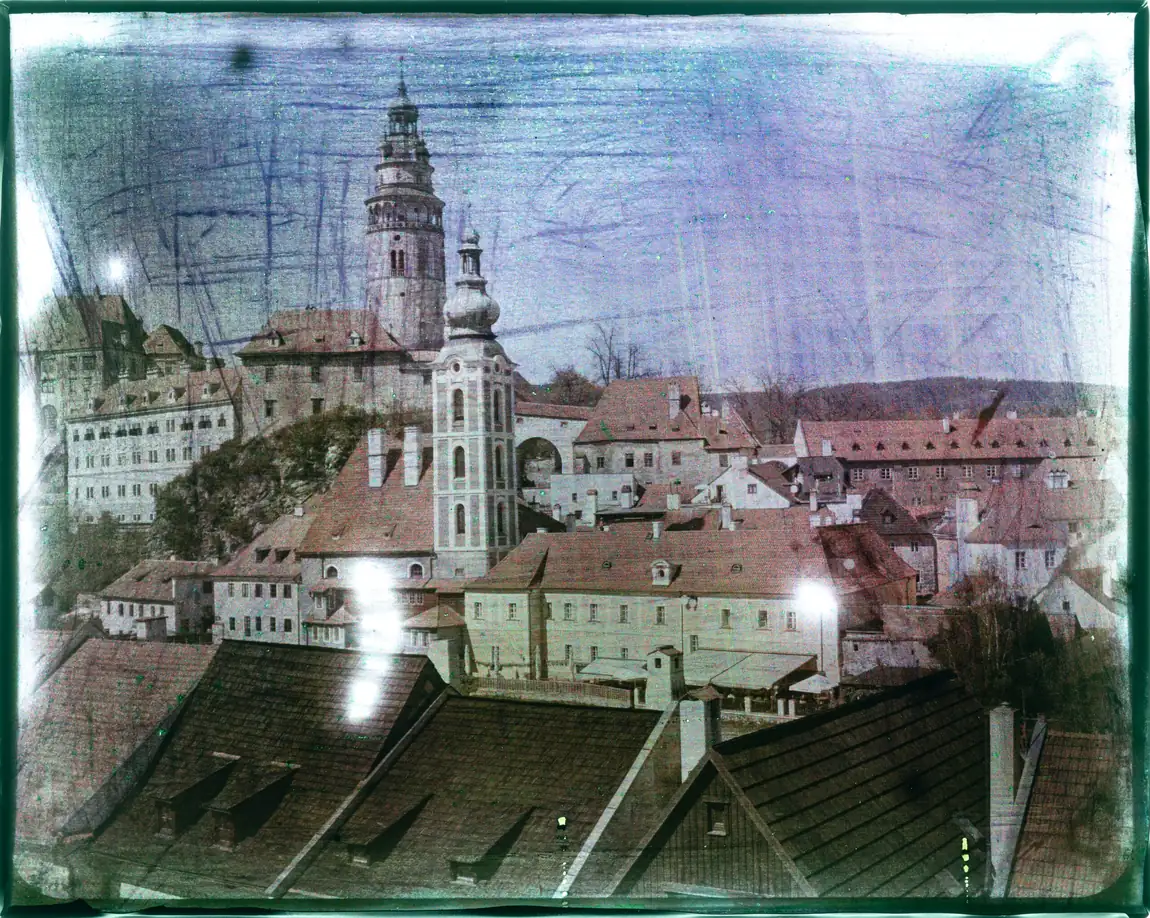
He does not claim to have resurrected 1907. Even a perfectly reproduced published formula uses different gelatin, different dyes, different glass, different chemicals and different equipment, and historical reconstruction always contains interpretation. What interests him is whether the principles can be understood deeply enough for the process to live rather than be imitated.
The remaining list is long and entirely concrete: sorting starch to size at scale, distributing the screen evenly across bigger plates, compressing it to an optically stable layer, making a high-speed panchromatic emulsion in volume, and coating that emulsion, reliably, in the dark.
In 2017 Autochrome was almost mythical to me. Once you have actually made one, it stops being mythology and becomes materials: starch, dyes, carbon black, gelatin, silver halides, glass. In one sense that demystifies it. In another, I find it much more extraordinary now because I understand how absurdly difficult it is that all of those things work together at all.
Nejc UrankarThe student who wanted to make a colour photograph out of glass, silver and microscopic grains of dyed potato is no longer proposing a hypothesis. There is an image on the plate.
Now we have to make it positive.
Nejc Urankar