A mail shirt is a document. Nobody wrote it, and it was never meant to be read, but the information is in there: how many people made it, what state their tools were in, whether they were working from scrap or from scratch, and the moment one of them noticed he had gone wrong.
Nick Checksfield has been reading it for thirty-four years. He has conserved and restored every piece of non-European mail in the Wallace Collection — over a hundred and fifty items — and the citation for his Heritage Crafts lifetime award notes that among his discoveries was that one of the original makers had been left-handed.
He works from Kent, and has restored for the Wallace Collection and the V&A, for countless dealers and private collectors, and for many years taught at Windsor Castle. He has been at it since 1992, and he is clear about where it started. “I have always been interested in history, but my interest was piqued when I met Pete Butler of Saxon Village Crafts,” a living history group built around craft. Butler, he says, pushed him towards authenticity and towards knowing that there is always something more to find out. “He lit a spark in me that’s still burning, which is why I now try and spread the spark as much as possible.”
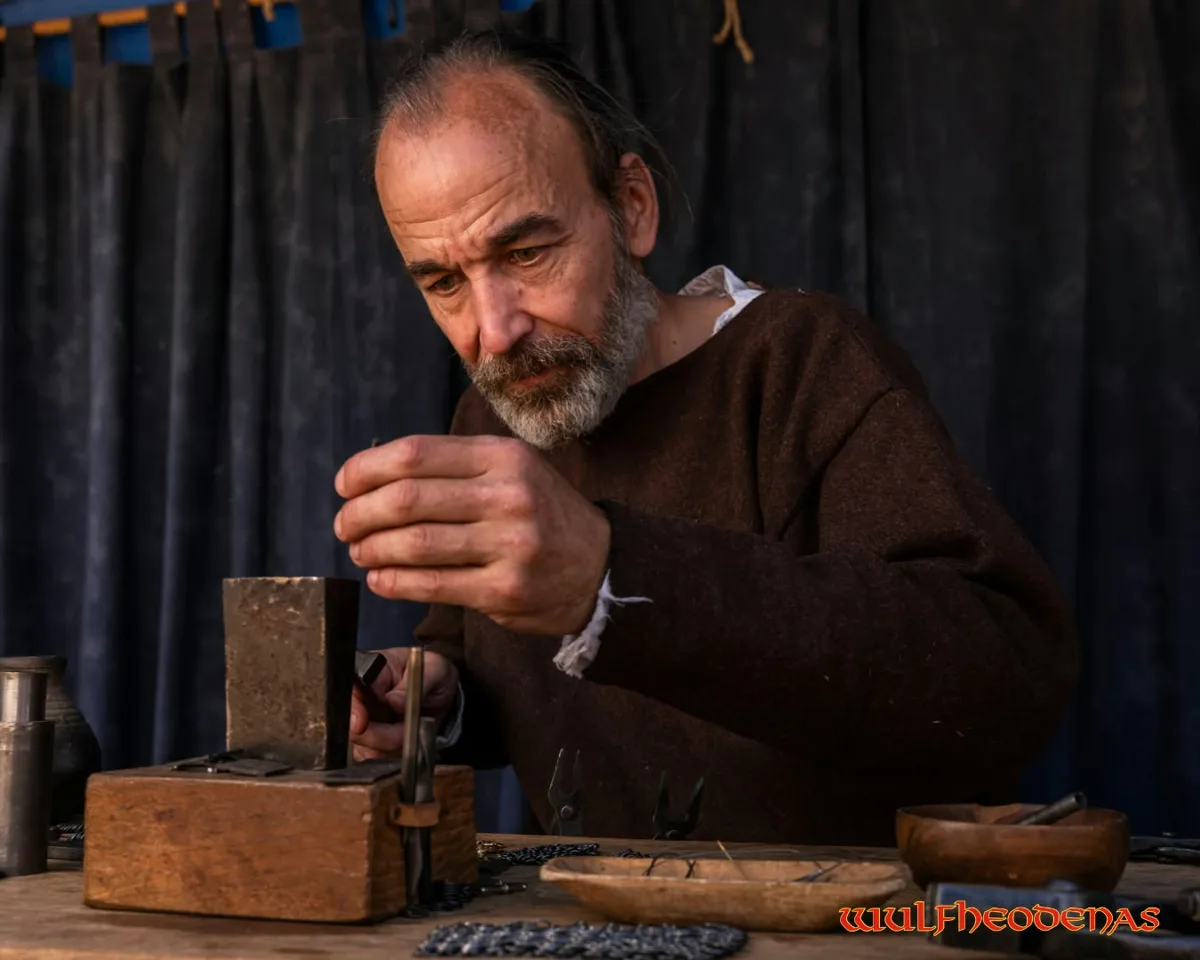
It is worth knowing what the document costs to write. A medieval mail shirt runs to between twenty-eight and fifty thousand rings; a long-sleeved hauberk of fine rings can reach a hundred and fifty thousand. Each ring is drawn as wire, wound on a mandrel, cut from the coil, softened in the coals, lapped, flattened where the rivet will go, pierced, woven into its four neighbours and finally riveted shut. Five to eight operations, repeated tens of thousands of times, by hands that were getting tired — which is the other thing Checksfield can see.
The left hand
His own account is more careful than the citation, and better.
“With some Indo-Persian mail, the rings are butted, and sometimes you can see how they were opened, which can indicate that they were put in with the left hand,” he says. “Admittedly this doesn't necessarily mean they are left handed, but if a piece is mapped in detail you start to see a pattern. One I worked on, the rings had been consistently opened in a left handed manner.”
Then comes the part that turns an impression into evidence.
I am aware this doesn’t prove anything, but I get exactly the same results when doing it myself. I use both hands.
Nick ChecksfieldHe is ambidextrous. So he can produce the pattern on purpose, and compare. The claim is not that he can sense a dead man's handedness; it is that he ran the experiment on himself.
What else is in there
A great deal, once you know the object is talking.
He can tell whether the tool in use was new or worn, which in turn indicates how many people were working on the piece, and whether they were using scrap or making from scratch.
You sometimes see where they’ve made a mistake, and where they realise they’ve made a mistake. This is always pleasing to see.
Nick ChecksfieldAnd some of the writing is deliberately concealed. “If you ever see a khula khud — an Indo-Persian helmet with a spike — that has a gold flower or bird on the bowl, there is a chance that it is hiding a crack or defect underneath.” The decoration is a patch. Somebody four centuries ago covered his mistake with something beautiful, and it worked until it met a man who knew where to look.
The other history
Against the object's legibility runs a long history of people destroying it.
Checksfield describes one coat found in India: European made, taken — possibly by the Ottomans — and repaired by them, then carried to India where it was mended again, and finally patched by the Victorians, badly. Four hands across three cultures, each leaving its own layer, all of it still readable.
That is the good outcome. The bad one is more common. “There have been instances where rings from a different coat have been de-riveted and used to mend something else. In one case, about eighteen patches from different garments had been cut up and stuck together, losing any kind of history or provenance.”
The record bears him out. Nineteenth-century dealers cut up genuine mail shirts to assemble rarer objects, closing the joins with cheap butted rings; they aged pieces with acid, added false marks, and built composite armours out of parts from different centuries and countries. One dealer removed the date from an 1844 Iranian helmet so it could be sold to the Marquess of Hertford as an eighteenth-century piece — Hertford being the man whose collection became the Wallace.
Then there is the cleaning. Armour was scoured with emery, wire brushes and sand mixed with vinegar, or dipped in acid baths, so that it would gleam on a hall wall. “Combine that with acid cleaning, which destroys any evidence of tool marks,” Checksfield says, “and you have destroyed something that had survived for hundreds of years.”
He does not soften the verdict.
Unfortunately the Victorians, dealers and inexperienced people have a lot to answer for.
Nick ChecksfieldWhich is why he signs
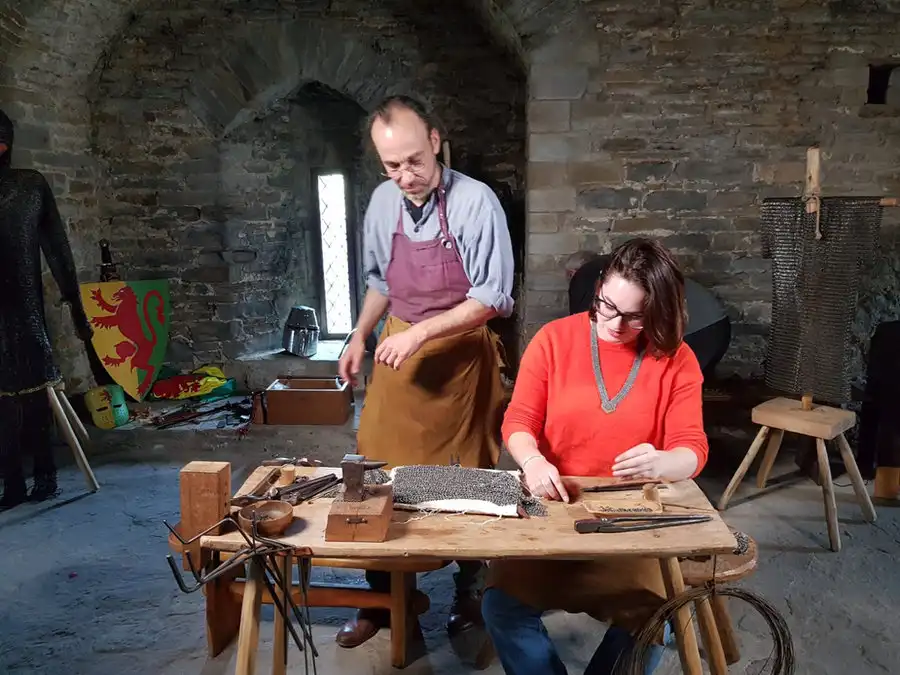
Every ring he inserts is stamped with his initials or the museum's mark, and accompanied by a written report and a photographic record made before, during and after. He is deliberately making his own work findable by whoever comes next.
It would be neat to call this the opposite of the Victorian mender, who wanted his work to vanish. It is not quite that. “The idea is to make the restoration unnoticeable unless you look at the back,” Checksfield says. The repair is meant to disappear into the object; the admission that it is a repair sits where only somebody who knows to turn it over will find it. The story is kept, and so is the fact that he was there — but on the inside, addressed to the next restorer rather than to the room.
Twice the price of plate
Mail has always been expensive, and the reason is labour. A mail shirt took something like two months to make; a cuirass took two days. Checksfield puts it conservatively: mail was traditionally twice as expensive as plate, “and this hasn't changed — if anything it may be more so, as modern makers don't have entire towns making it. The various stages are now performed by one person as opposed to many.”
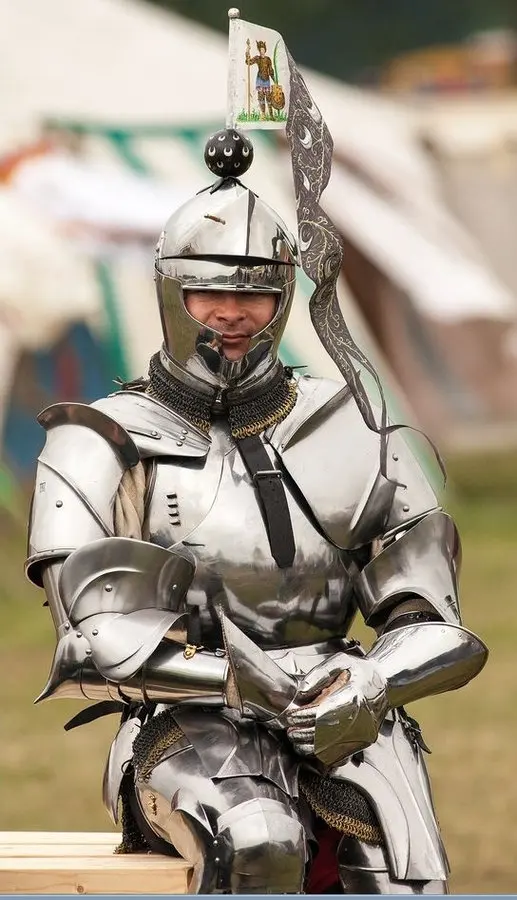
The consequence is visible at every joust. Most of the mail worn by people who actually get hit is imported Indian work, bought cheap and then taken apart and re-tailored to the wearer. “Even people who strive to make their armour perfect, spending tens of thousands on plate, will sometimes only want to spend pennies on the mail.”
Looks and protection
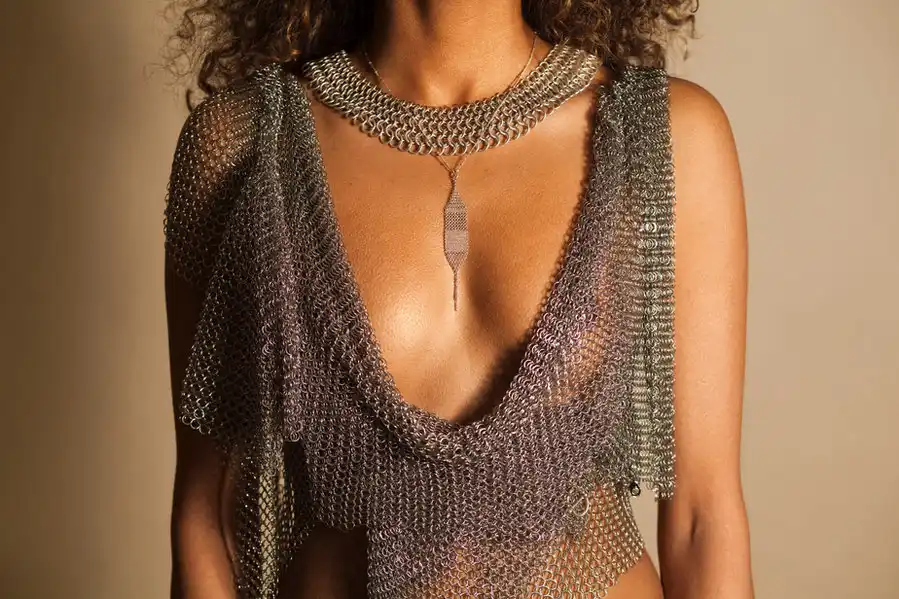
Restoring both traditions taught him what each was for. Eastern makers, and Indian makers in particular, “go for looks, patterning their mail sometimes using very small butted rings which look fantastic but would give little protection.” Their coats have voluminous armpits to allow movement. Good European mail is tailored to the person.
It also taught him to tell an original fault from a dealer's intervention from simple bad storage. “If you are restoring and you don't understand these things, you can do irreparable damage.”
The book that is not written
Maille making sits on the Heritage Crafts red list as critically endangered. Nothing survives from the middle ages explaining how it was done: no manual, no treatise, not a page. Everything now known has been worked backwards out of the objects themselves, which is why the acid baths matter so much.
Checksfield teaches short courses — history, wire drawing, winding, cutting, then riveting, ring forming, drifting, and a pattern drawn up if the student has a project in mind. He has also taught restoration, “but this has to be done very carefully, as a little knowledge can do a lot of harm. Too many times I have seen people butcher a perfectly good piece, sometimes destroying it because they didn’t know what they were doing.”
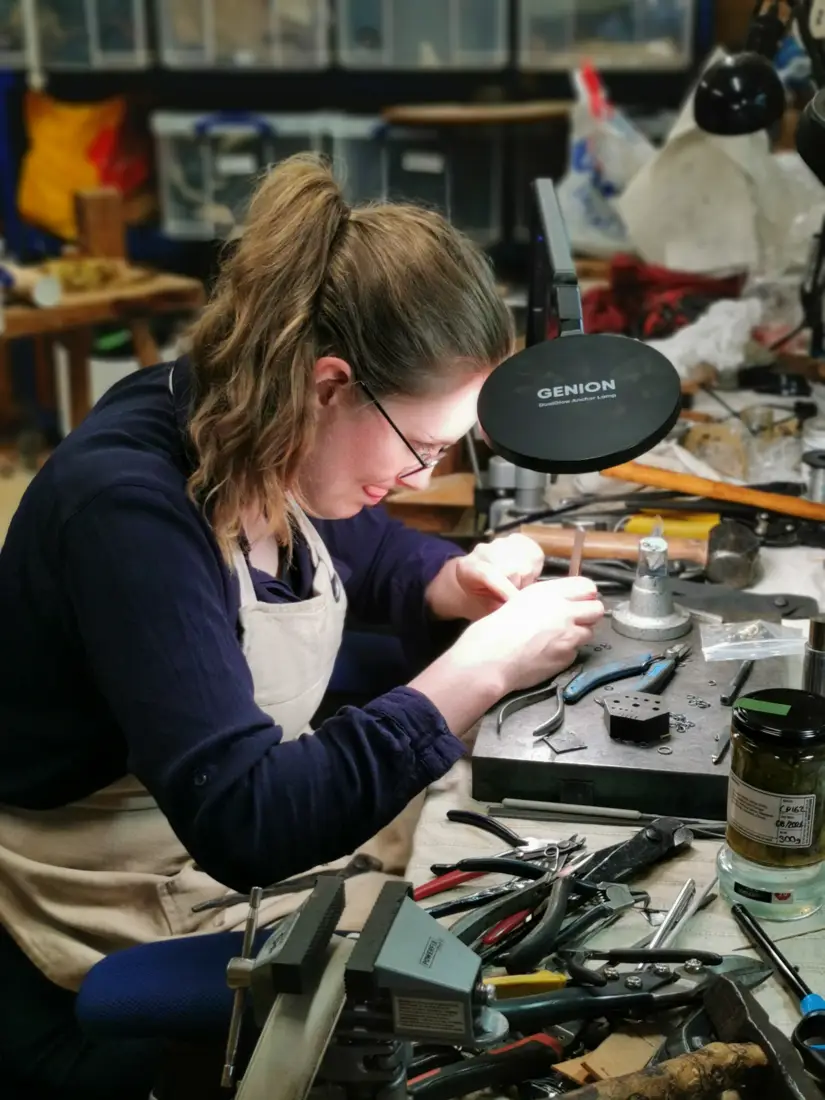
He has an apprentice, Elizabeth Champion. “Apprenticeships work well as I can warn them of the mistakes I made, thereby speeding up their progression.”
And there is the other thing.
I have been trying to write a book for many years, with all the things I have learnt over the last thirty-four years. One day I may get round to it.
Nick ChecksfieldThe medieval makers left no book either. What they left was the work, and a man who could read it. That has held for eight hundred years, and it is holding now, which is not the same as being safe.