A rainbow is a poor subject for a museum until someone notices that it only exists where you stand. Olafur Eliasson has spent three decades treating natural phenomena not as scenery but as apparatus: mist plus spotlight, moss plus wall, monofrequency light plus your eyes. Your curious journey, at the Museum of Contemporary Art and Design in Manila through 15 November 2026, is the final stop of a Pacific tour that began at Singapore Art Museum in 2024. The works do not import a sun. They import the conditions under which you remember how to see one.
Manila is not a neutral terminus. The show has already passed through Auckland, Taipei and Jakarta; after Malate the crates return to the Berlin studio. Eliasson, Icelandic-Danish, born 1967, founded his craft-and-research workshop in 1995 and since 2019 has carried a UNDP title for climate action. This is not a wire-service climate lecture. It is a show about perception that refuses to let perception stay innocent.
The apparatus left in plain sight
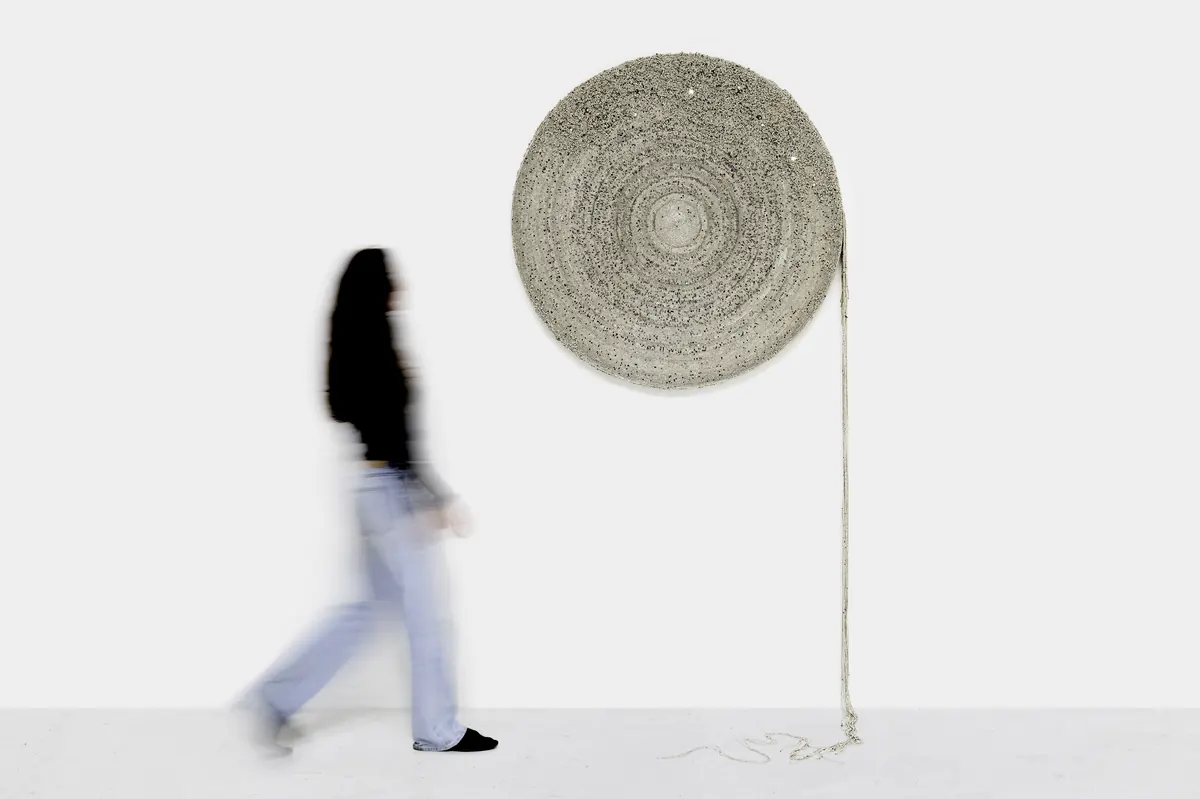
Beauty (1993) is almost too simple: water nozzles, a hose, a pump, a single spotlight. Stand in the right place and mist becomes a rainbow; shift a step and it dissolves. No two visitors share the same prism. Yellow corridor (1997) floods a passageway until faces and fabrics collapse into yellow-and-black, then hands you back to daylight. Moss wall (1994)—reindeer lichen woven into wire, breathing in the room—smells before it symbolises. Ventilator (1997) is a fan suspended on its own air. Eliasson leaves the motors visible. Illusion is a tool; secrecy is not.
Readers of this magazine who sat through Abramović's empty rooms will recognise the wager: the work is incomplete until a body arrives with its own attention. Eliasson writes it more gently—artworks become complete when the viewer engages—but the demand is the same. Looking is labour.
Ice that has already left
Climate enters as form, not caption. The glacier melt series 1999/2019 restages Icelandic viewpoints twenty years apart: thirty C-prints of what the same ground no longer holds. The last seven days of glacial ice (2024) casts stages of a melting block from Diamond Beach, each bronze paired with a glass sphere equal to the water lost—elegy as measurement. Freight itself becomes drawing: The seismographic testimony of distance lets pens ride the crates, marking every jolt of a tour that tried, to keep carbon in view.
The dissenting beat is not optional. Critics have long asked whether Eliasson's orchestrated weather is pedagogy or aestheticised control; whether shipping glacial ice for Ice Watch spent the climate it claimed to make tangible. A travelling survey of light and moss cannot cancel logistics. Manila, among the most climate-vulnerable capitals on the circuit, sharpens that friction. The show does not resolve it. It places the friction in the room.
Where the tour chooses to end
Upstairs, silhouettes collide in coloured beams (Your pluralistic coming together, 2024). Driftwood finds north (Adrift compass, 2019). Shadows rotate while motors stay unhidden (Life is lived along lines, 2009). The sequence is almost classical: desaturate, then re-enchant; measure loss, then hand agency back. Compared with the silver memorials of Sugimoto's dying emulsion, Eliasson still believes the eye can be retrained—not by mourning a medium, but by rebuilding weather indoors until outdoor weather feels newly strange.
What remains, when the rainbow is gone, is the craft this magazine defends in praise of the visible hand: materials left honest, processes left legible, the viewer not flattered but required. Three years of crates, five cities, one final Malate hang. The curious journey was never the itinerary. It was the moment you realised the rainbow needed you—and that needing you is the whole point.