
The title is an order. Kala is an isiZulu imperative — weigh it, measure it — and it lands at a moment when almost everything already is being weighed. Output, engagement, productivity, worth: this age has no shortage of scales. Simphiwe Buthelezi's first solo exhibition with Southern Guild, opening in Cape Town on 18 September, takes the instruction seriously and then turns it over. The question is not how we measure the world. It is what we have agreed to count.
What she proposes measuring instead is the list no instrument was ever built for: hope, memory, collective dignity, spiritual inheritance, and the distance between who we are and who we might yet become. To do it she has made a set of devices — a star, a smoke, a globe, a counting frame — which look like navigational instruments and refuse, one by one, to give a reading.
An abacus released from its frame
The most literal of them is also the most disobedient. The Abacus is a wall-hung installation in which ebonised clay beads, each made by hand, travel along open contour lines instead of the four-sided wooden frame the device has carried for two thousand years. Freed from that boundary, it can no longer hold a total. Beads can be added or lost, shifted by time and touch; the instrument becomes porous, and no reading is ever final.
An abacus is a machine built for commercial certainty — the oldest technology we have for turning things into sums. Hers keeps count of what will not sit still.
There is a second history inside the material, one this magazine has followed before in the beadwork of Bolgatanga. For centuries on this continent the bead was the unit of reckoning: strings of them were exchanged for cattle, for land, for people. Buthelezi builds counting instruments out of the very object once used to price a human being, and then removes its ability to arrive at a figure. The gesture is not decorative. It is a refusal delivered in the language of the thing itself.
A star that comes undone
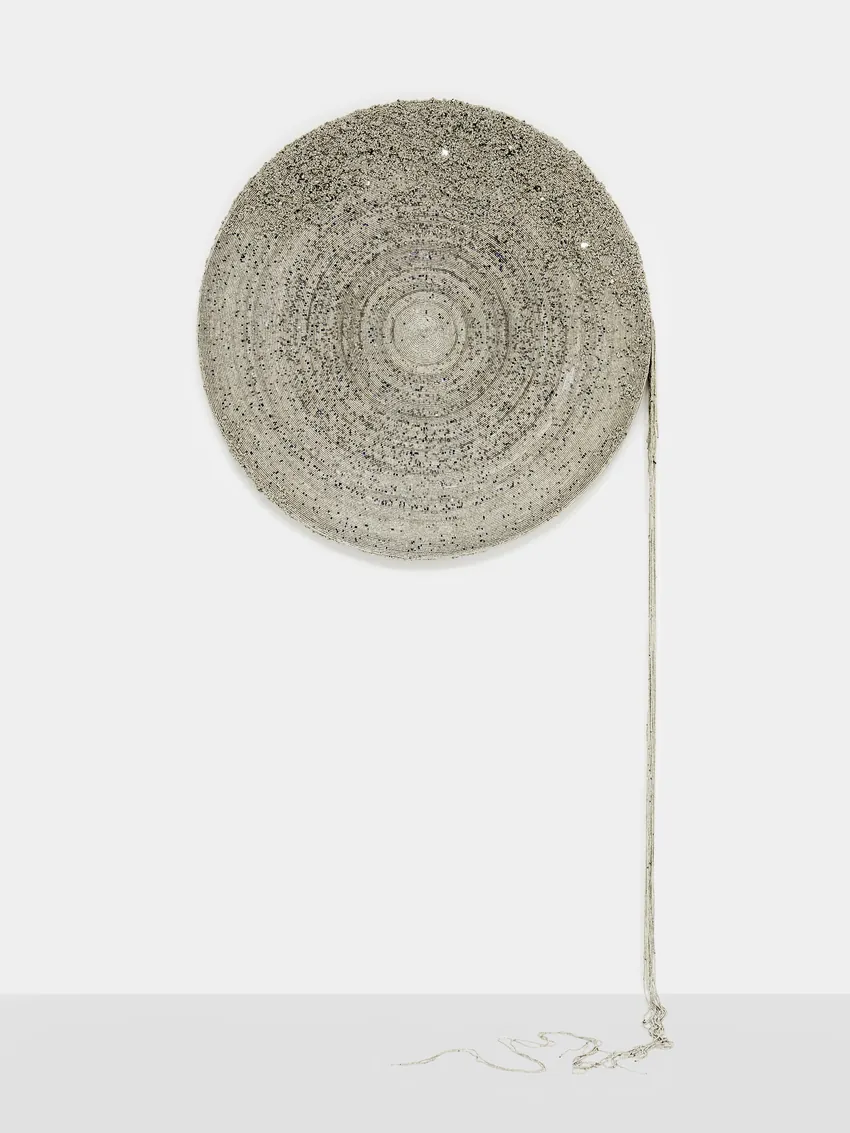
Simphiwe Buthelezi, Nkanyezi (2026). Image courtesy of Nanje Nowack/Southern Guild.
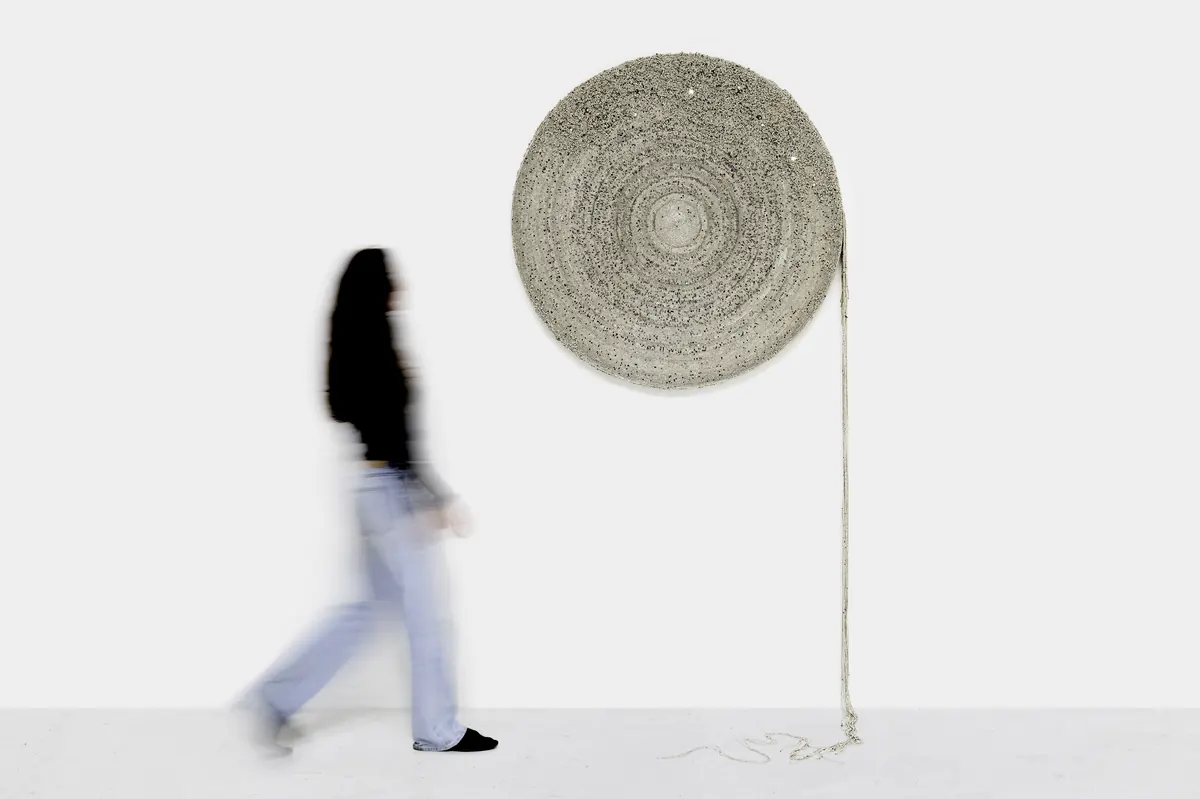
Nkanyezi means star. The work is a disc built outward from its centre in tight concentric rings — the coiling logic of a grass mat, performed in glass beads, silver-grey with a scatter of black and blue like a night sky photographed and then reversed. For most of human history the star was the instrument: you established where you stood on the earth by looking away from it, and every map of the sea depended on that habit.
Then the work does something a navigational chart would never do. From its right edge a single strand escapes, runs down the wall, and gathers on the floor in a loose, deliberate tangle. The object is coming undone in front of you, at its own pace, and the artist has let it.
“It fascinates me how a single object can unravel and transform into many forms,” Buthelezi has said, “just like the people to whom it belongs: boundless, adaptable, enduring.” Most artists' statements sit at a polite distance from the object. This one is simply a description of what is happening on the wall.
The smoke that has been surveyed
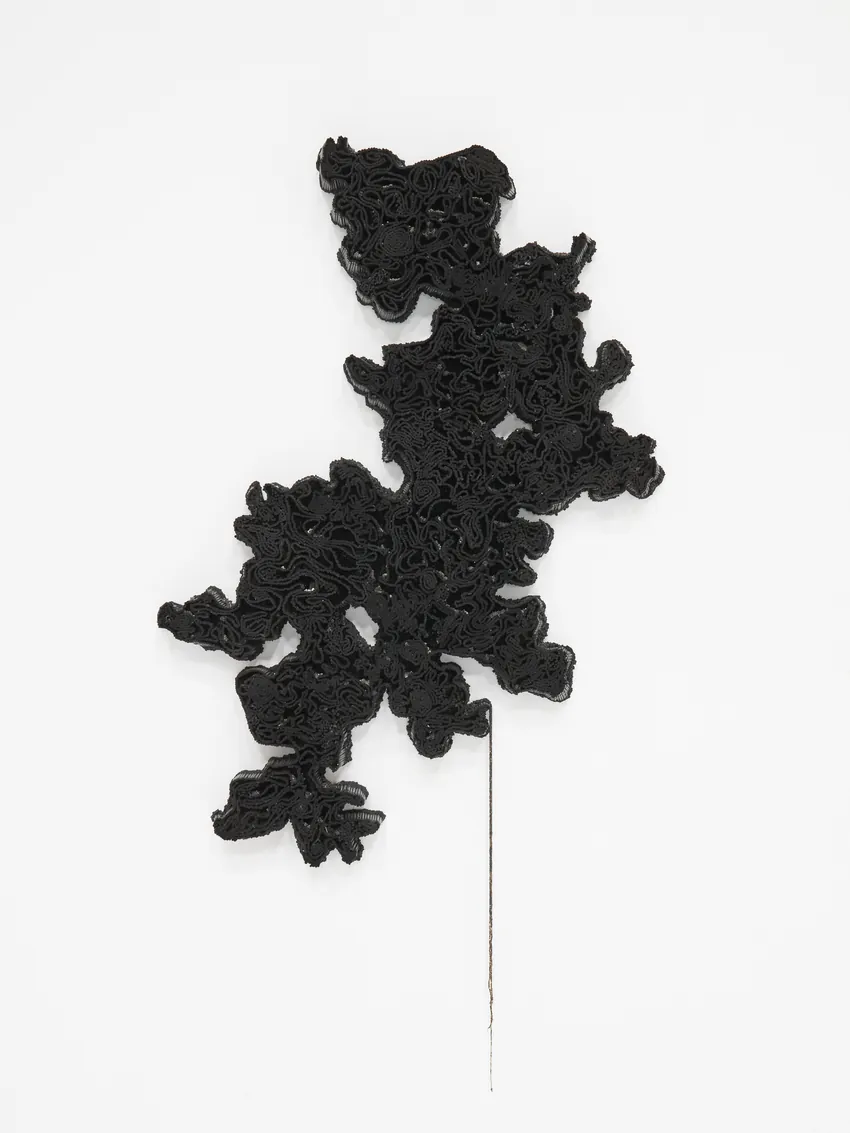
Simphiwe Buthelezi, Ntuthu (2026). Image courtesy of Nanje Nowack/Southern Guild.
Its opposite hangs nearby. Ntuthu means smoke, and the work has the ragged coastline of a landmass drifting apart — a continent, a cloud, a Rorschach blot that has been mapped. Its surface is worked into winding beaded lines that read exactly like contours on an ordnance map, complete with the small closed rings that mark a summit.
Smoke is the standing example of what cannot be measured. No fixed edge, no volume that holds still, gone while you are still looking at it. Buthelezi has rendered it in the most patient medium available — thousands of beads, set one after another — and given it the appearance of surveyed ground. It is a joke of a very serious kind: the surveyor's language applied to the one thing that will not hold a shape long enough to be surveyed.
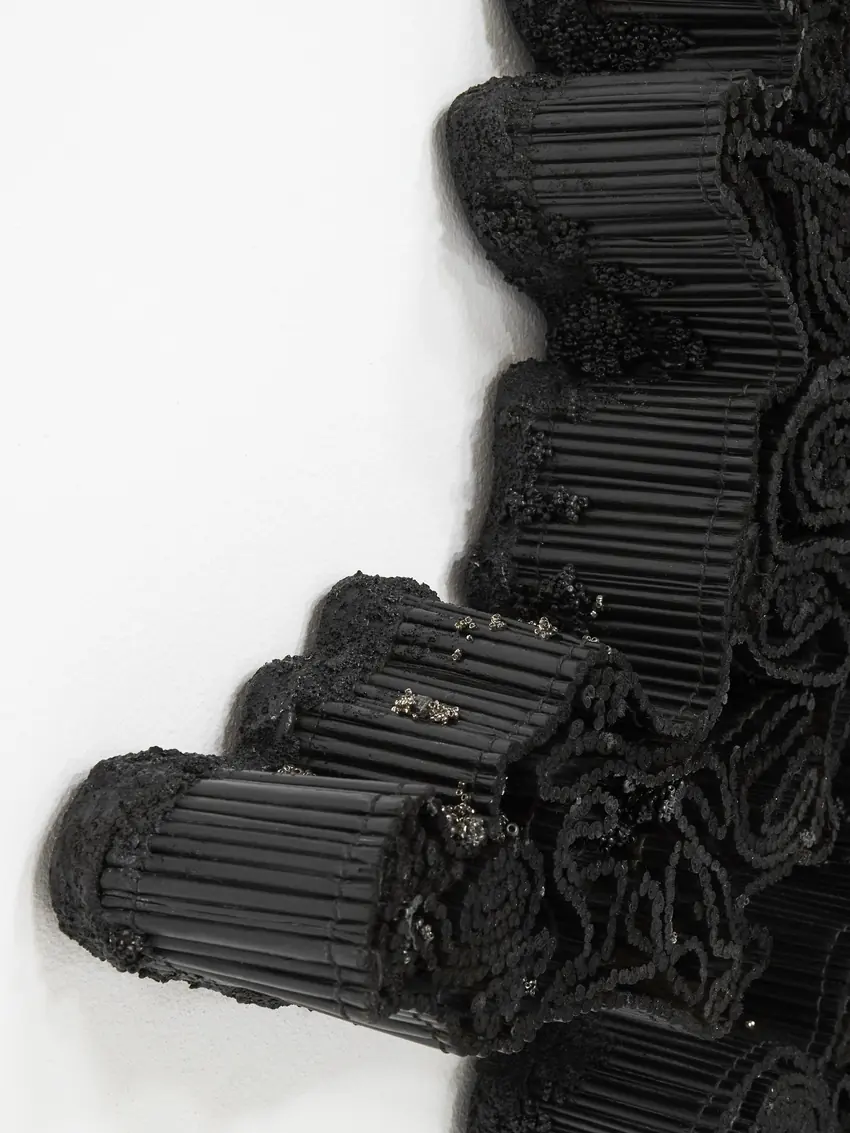
Ntuthu (detail). Image courtesy of Nanje Nowack/Southern Guild.
Up close the material gives away something the wider shot conceals. The black mass is built from bugle beads — long tubular glass — laid in tight bundles, and bundled tubular beads look uncannily like stalks. Like reeds, cut to length and packed together. Like reeds that have been through a fire.
Buthelezi's principal material, in this show and for years before it, is icansi: hand-woven mats made from iNcema bulrushes. Reed is the substance of her practice, and in Zulu tradition the reed is where the first ancestor came from. Here is that same material apparently charred, blackened, held together in bundles, and arranged in the shape of the smoke it would become. She has described the mat elsewhere as a metaphor for a woman, an object that gets “shredded, burnt, stained and stretched”. Ntuthu is what stands at the end of that sentence: not the mat, and not the fire, but what leaves the room afterwards.
The oldest instrument in the show
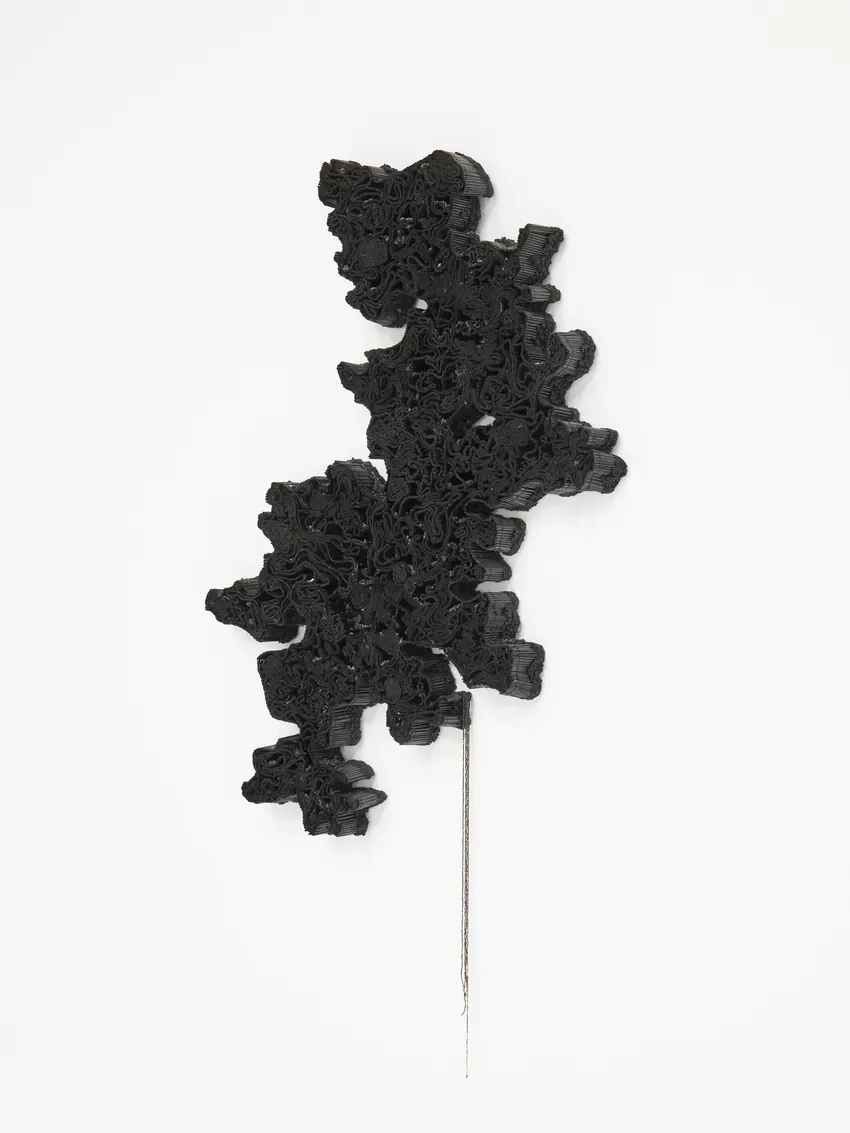
Ntuthu (2026), viewed at an angle. Image courtesy of Nanje Nowack/Southern Guild.
Both works send a thread down toward the floor. On the star it is a thick beaded rope that pools; on the smoke it is a thin, almost invisible line, hanging dead straight.
Whatever else that line is doing, it is the oldest measuring device humans possess. A plumb line — a weight on a string — is how every wall in the ancient world was built true. It is also the only instrument in the room that cannot be argued with, because it takes no reading from the person holding it and answers to gravity alone. In an exhibition about the failure of metrics, Buthelezi has hung, beside each of her uncountable objects, the one measurement nobody can dispute.
The globe that is not intact
At the centre of the show sits Mhlaba — earth, or world — a monumental sphere the gallery describes as neither complete nor intact, suspended between formation and erosion. Its surface is layered with what the exhibition calls tactile constellations, built from cut segments of those same reed mats: the objects South Africans are born on, sleep on and are buried on, used across ceremony, ritual and ordinary domestic life.
To build a planet from them is to make a specific claim. A world is not only a geological body but a domestic surface, and both can be worn through by use. The globe refuses the other thing a map does, too: you cannot rule a sphere into portions and divide it at a table. That has always been the appeal of the flat map to the people doing the dividing.
The recurring forms across the show — orb, contour, grid, horizon — function, in the exhibition's own phrase, less as symbols than as devices of orientation. That is the argument in one line. Measuring is never neutral arithmetic; it is how you locate yourself, and it always begins with somebody deciding where zero goes.
The labour is the unit
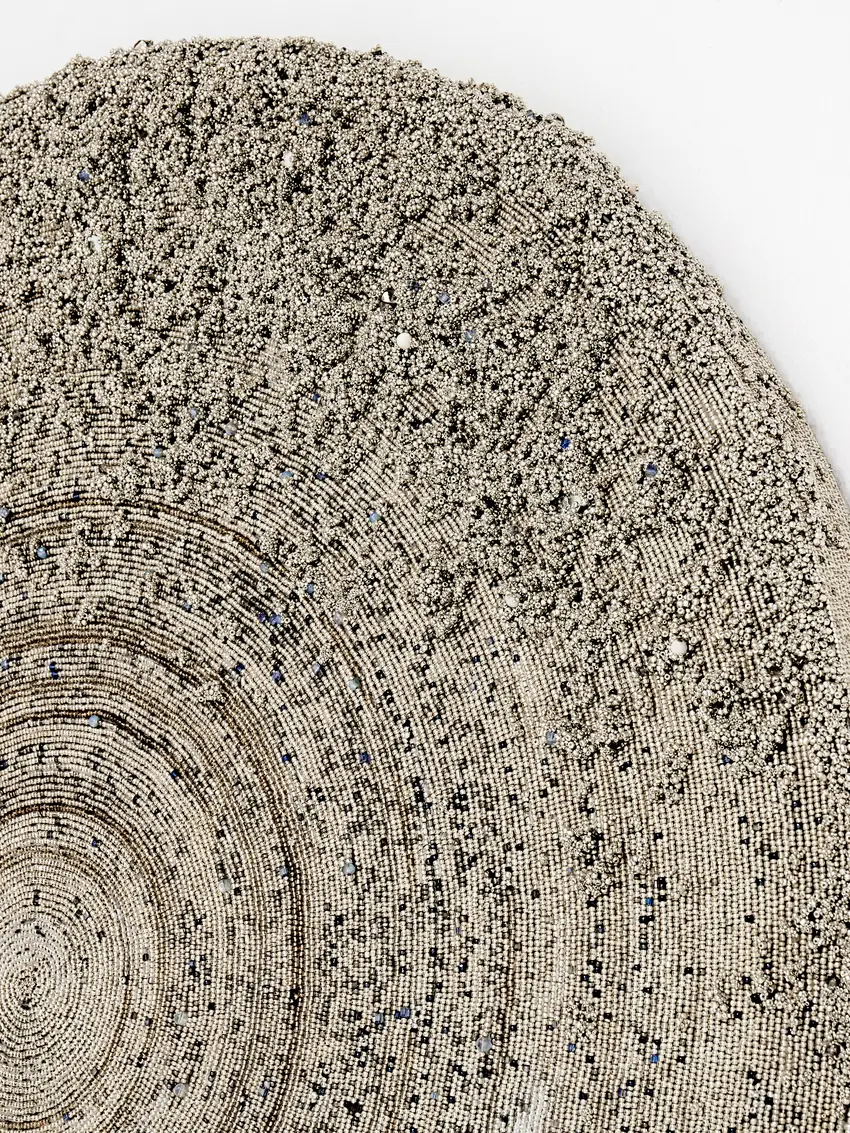
Nkanyezi (detail). Image courtesy of Nanje Nowack/Southern Guild.
Look closely at the star and the arithmetic returns, from an unexpected direction. Every one of those beads was placed by a hand. The spiral tightens toward the centre and loosens at the rim; in places the surface erupts into drifts of loose beading, like a star cluster resolving under magnification.
Buthelezi cuts, folds, sews and bonds materials handed down across generations — a practice she calls ukubuyela emasisweni, returning to the source, and which she has never let anyone mistake for nostalgia. Each repeated gesture records duration. The work does not depict time; it accumulates it, the way sediment does. In a market that prices output, she offers a different currency: attention, spent visibly, at length, and impossible to fake. You cannot rush a surface like this, and you cannot pretend to have made it.
What we choose to count
Buthelezi was born in Johannesburg in 1996, took her diploma in fine art in 2017, won the Blessing Ngobeni Prize the following year, and has spent the years since between residencies — Brussels, Vancouver, Morocco, and two months at the gallery's own GUILD Residency in Cape Town, out of which this exhibition came. Her work sits in collections from Antananarivo to Turin.
“I am aware that I am ancient,” she has said. It reads as mysticism until you see what the sentence produces: a star that is quietly taking itself apart, a smoke that has been contour-mapped, a globe worn thin, and a counting frame with the frame removed. She is not arguing that measurement is worthless. She is pointing out that we have built exquisite instruments for the things that can be totalled, and almost none for the things that matter — and that this was a choice, not a limitation of the technology.
Vessels that talk back prepared us for objects with opinions. These ones go further. They hand you an instrument, let you hold it, and decline to tell you what the reading means.
Kala runs at Southern Guild, Silo 5, V&A Waterfront, Cape Town, from 18 September to 12 November 2026.