For most of art history the vessel has been the help. It stood in the corner, held what it was given, kept quiet, and let painting do the talking. Xanthe Somers builds vessels that have opinions. Monumental, hand-coiled, riotously ornamented, they stand in the gallery the way someone stands in a doorway when the conversation is overdue.
Born in Harare in 1992, Somers took a fine art degree at the University of Cape Town and then, in 2020, an MA with distinction in Postcolonial Culture and Global Policy at Goldsmiths in London — a sequence that explains a great deal. The theory did not replace the clay; it gave the clay a case to argue. Her vessels now sit in the Victoria and Albert Museum, carried her to the 2024 ANNA Award for African women artists, and this year put her on the LOEWE Craft Prize shortlist — the thirty-strong list this magazine has been following, essay by essay, since Jongjin Park's win.
Weaving, translated into clay
Her method begins obediently: coils of clay laid ring upon ring, the oldest grammar of Zimbabwean pottery. Then the disruption starts. Surfaces are punctured and woven through; sculpted flowers attach themselves; gold lustre spreads over everything like wealth over a wound; nylon cord threads the fired stoneware. The weaving is not a flourish, and it is not a copy either. The technique sits closer to the rattan furniture of Zimbabwe than to any museum basket; what Binga gave her was not a pattern but a politics. The region lost its land when the Kariba dam flooded the Zambezi valley in the late 1950s, moving more than 57,000 people, and it sharpened her interest in what grass baskets carry and who is paid for making them. Carried into clay, weaving becomes a device of metaphor and memory rather than a borrowed motif.
The invisible hand
Her 2024 solo at Southern Guild in Cape Town, made during her time at the GUILD residency, took Adam Smith's most famous phrase and returned it to its rightful owners — the hands the market never names. Invisible Hand consisted of three vessels, each over a metre tall, their titles lifted from Lucy Larcom's 1868 poem Weaving: Of Woof and Woe, pewter-grey and pearlescent, its heavy loops resolving into delicate three-strand braids; The Weary Weaver, wearing the green, yellow, red and white of the Zimbabwean flag, with rings looping through openings in the vessel's tangerine-coloured body; Tales Untold, glazed stoneware threaded with cord. Critics noted their commanding presence — scale doing deliberate work against the historical smallness assigned to craft. In the poem she wrote to accompany them, Somers asks: what tapestry are we creating, and what does the story say? This magazine once wrote in praise of the visible hand, the maker's mark left proudly in material. Somers works the other side of the same argument — making invisible hands impossible to unsee.
A clotheshorse, fired
Her LOEWE entry, shown with the other finalists at the National Gallery Singapore this spring, is titled The Caretaker's Clotheshorse: woven clay, glazed until it reads as fabric — a rack for drying laundry, the humblest possible armature of domestic labour, rendered permanent and monumental. Where Jane Yang-D'Haene gives the vessel memory and Morten Løbner Espersen gives it weather, Somers gives it a job history. “We create utilitarian objects to serve us, but ultimately these objects tend to outlive us,” she says. “These objects are not neutral, they carry within them the ideology in which they were created, and this legacy is not silent.”
That conviction has an origin story, and it is about returning home rather than any single object. Coming back to Zimbabwe after living away, she began to notice two dominant aesthetics competing for the country: Exotic Africa — paintings of animals and spears, tourist trinkets, cheap grass baskets — and Colonial Zimbabwe — portraits of white men, statues of Livingstone, silver tea sets, Chesterfield sofas. “The contrast between these two aesthetics made me realise that objects carry stories, as well as the ideologies of the people and systems that made them,” she tells us. “What was often missing between these two narratives was contemporary Zimbabwe: the country as it exists now, rather than as something exotic or colonial. That realisation made me want to make objects that draw from the past but are new and rooted in the present.”
The risk of the caption
Political craft carries a known hazard: the work can end up leaning on its wall text, a slogan with a glaze. Somers's insurance is labour itself. Weeks of coiling, weaving and firing cannot be skimmed the way a caption can; the argument is in the wrist long before it reaches the title — though her titles, like Like Stale Bread After a Hard Day's Work, pull their weight too. The names arrive late, and by design. The ideas behind them exist long in advance, but Somers waits until a piece has survived: “There are so many stages to get through first — the work might crack, collapse or explode. Therefore I reserve the naming for when I open the kiln after the final glazing.” A vessel changes character between building, drying, bisque and glaze; she names it on the evidence of the finished thing, in the first seconds of seeing it. A title, in other words, is not a plan. It is a verdict delivered when the kiln door opens. She speaks of the “subtle treason of objects”, and of weaving as “a wider metaphor for social cohesion, or lack thereof”. The ornament is not decoration on top of the politics. It is the politics, worn openly, the way a uniform is worn.
The house that shows her
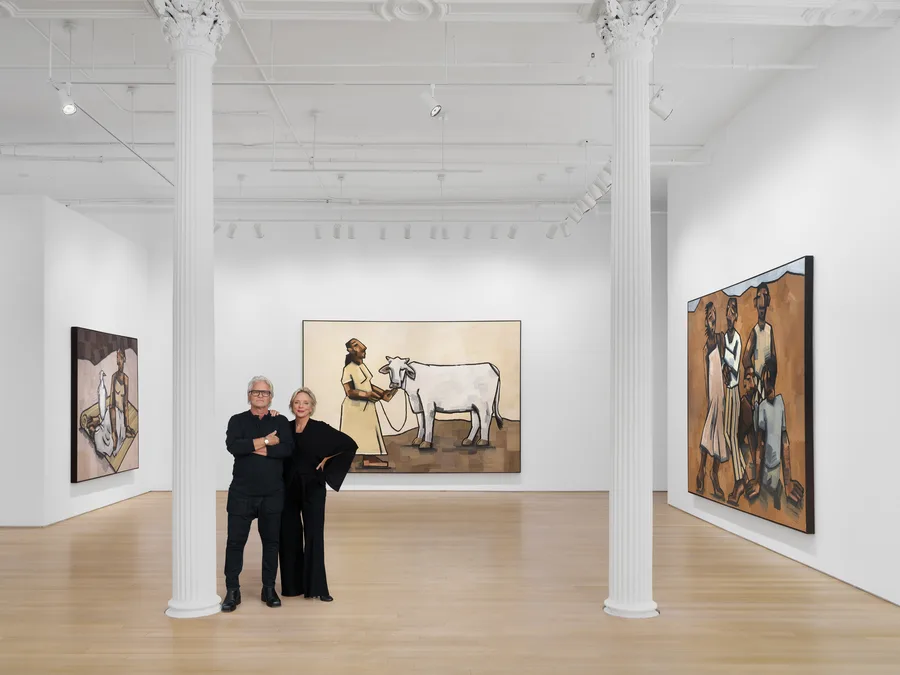
Trevyn and Julian McGowan, founders of Southern Guild, New York. Image courtesy of Erin Brady for Dan Bradica Studio/Southern Guild.
Somers's gallery is no accident of geography. Southern Guild, founded in 2008 by Trevyn and Julian McGowan and now bridging Cape Town and New York, was built on a guild's premise — collaboration, technical mastery, material integrity — and has pushed African design and art into the Met, LACMA, SFMOMA and the Art Institute of Chicago. Its residency programme produced Invisible Hand; its programme gave a loud vessel the room it needed. London, meanwhile, keeps calling: October Gallery showed her Cleaner, Carer, Mother, Maker series this year in Poetic Threads, a solo presentation alongside Moroccan painter Yacout Hamdouch, after taking her work to Africa Basel and 1-54.
The vessel will outlive us; Somers makes sure that when it does, it testifies.