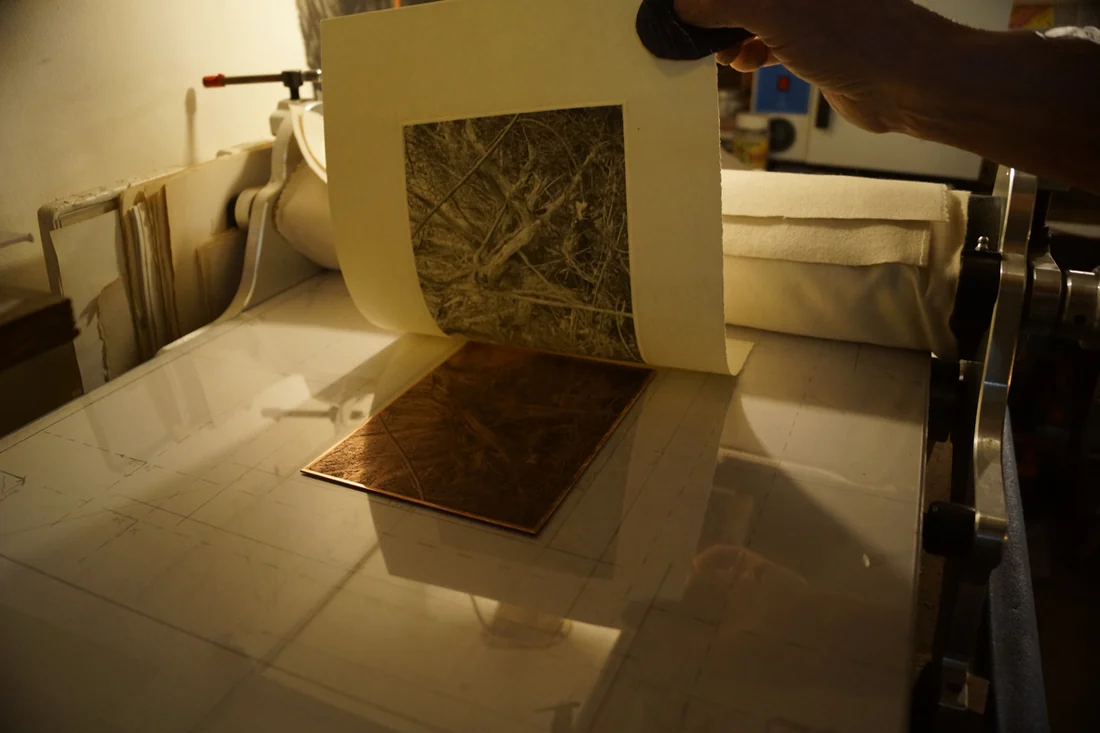
Photogravure has used chrome salts since 1852. Potassium or ammonium dichromate hardens a sheet of pigmented gelatin wherever light falls on it; the hardened gelatin is laid on a copper plate as a resist; ferric chloride eats the copper wherever the resist is thin, and the plate prints a photograph in ink, in continuous tone, with blacks no other process gives.
On 21 September 2017 the sunset date passed for potassium dichromate under the European chemicals regulation. Chromium VI compounds are carcinogenic; entry 19 of the authorisation list came into force, and the sensitiser of a hundred-and-sixty-five-year-old process stopped being something a workshop in France could buy.
There was an easy way out, and most people took it. Photopolymer plates need no chromium at all. Hervé Sachy refused it.
When I had made a few photopolymer plates, I had the impression of doing mechanical work that a well-adjusted machine could have done in my place, and obtained the same result.
Hervé SachyWhat he would not buy
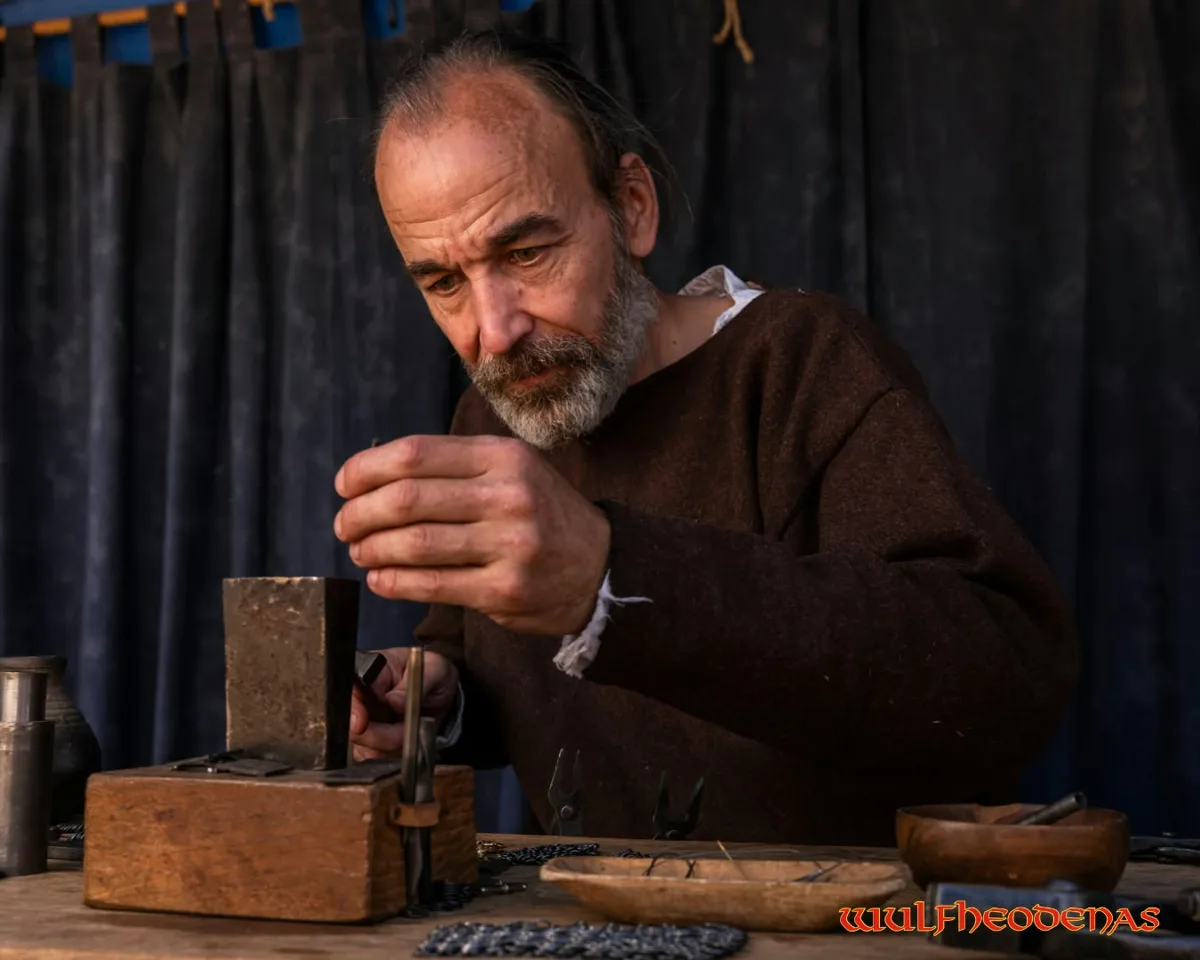
He came to photogravure as an engraver. Before it he had spent years on burin, etching, aquatint, drypoint, mezzotint and soft ground, some of it learned over a few months in a Paris workshop in the 1980s. Copper is the point: “a precious metal that gives back a warm light, incomparable and unique, that moves with the gaze.”
His first objection to photopolymer is a craftsman’s. Once such a plate is etched nothing further can be done to it — no burnishing, no re-biting, no drypoint over the top — and he never found in it the deep velvety blacks of gravure on copper.
The second objection is the one that decided it, and it is not about the image at all. A photopolymer plate arrives finished. Somebody else has coated it, and you are their customer. Sachy makes every part of his own: he starts at the photosensitive gelatin and stops at the printed sheet, and he says plainly why — so as not to depend on a manufacturer of plates. What he refused to give up was not a look. It was total command of a process from the first step to the last.
I feel photogravure more as a language or a music: the more words or notes available, the more one has the possibility of making a beautiful text or a beautiful melody. The more complex the process, the more the hand of man can make something beautiful — and in return it demands more work.
Hervé SachyThe first substitution
There was also a practical reason to find a replacement rather than change trades. He runs courses. Two and three days at a time, in his workshop at Pont-Saint-Esprit in the Gard, for photographers, engravers and artists, most of whom have never done photogravure.
“It was not possible,” he says, “to teach a forbidden technique whose main product cannot be obtained.”
So from 2017 he taught it with diazidostilbene — DAS — already proven in collotype and carbon printing. It took him a while to get it right and then it worked very well. But it cost far more than dichromate ever had, had very few distributors, and gradually became unobtainable worldwide: a complex molecule that cannot easily be made without Chinese laboratories, which impose large minimum orders. And, he adds, one is not certain of its non-toxicity. He still has some in the studio and would use it if a large plate were ordered, because the process that replaced it has not yet been tested at that size.
Which is the shape of the thing. Twice now what failed was not the chemistry and not his hands. It was a supplier. No more chrome, no more DAS; a solution had to be found.
A printout, kept
Around 2010, browsing for anything at all on a process almost nobody documents, he came across a publication on citrated gelatin. He read it, did not understand all of it, and put it somewhere in the studio.
It was Halvor Bjørngård’s master’s thesis of January 2007, written while he was studying at Chiba University in Japan: The Chiba System: a non-toxic alternative to the dichromate processes. Bjørngård had replaced chrome with ferric ammonium citrate — the iron salt of the cyanotype, also used in medicine and in food — for carbon printing on paper.
Then, with chrome gone and DAS going, he found the printout again and read it properly this time, and then read it again, and again. It remains, he says, the largest single source behind everything that followed: in it are all the keys to understanding the chemistry of the process and to setting every one of its parameters. He had never believed chrome was irreplaceable; he says so flatly. What he had lost was the ability to buy things.
His first citrate trials are dated 23 February 2023. They went badly and he published nothing. He came back to it on and off through that spring and summer. Then, on 6 September, he took it up in earnest, because by that point DAS had become impossible to buy at all. What remained was the part Bjørngård had not done: making it work on metal.
Five minutes thirty-five
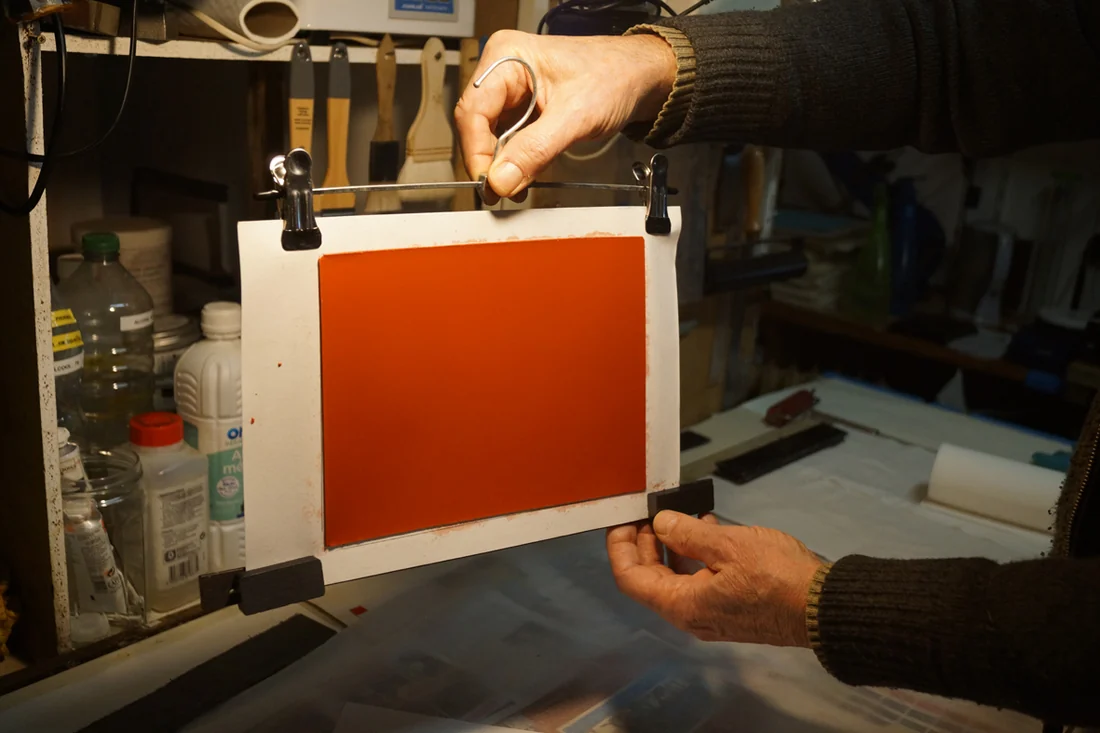
What he was moving to is not a substitution but a different mechanism. With dichromate, ultraviolet acts on the gelatin and hardens it. With ferric citrate the light does nothing to the gelatin whatever: it changes the iron, reducing Fe³⁺ to Fe²⁺. A second step is then needed — a very dilute bath of hydrogen peroxide, which starts a Fenton reaction and generates free radicals that polymerise the exposed gelatin in proportion to the light it received. The picture is not made by the light. It is made afterwards, by the water.
The first price is paid in time, and he publishes it as a single line: a positive film that took two minutes under dichromate, and two and a half under DAS, needs five minutes thirty-five seconds under citrate.
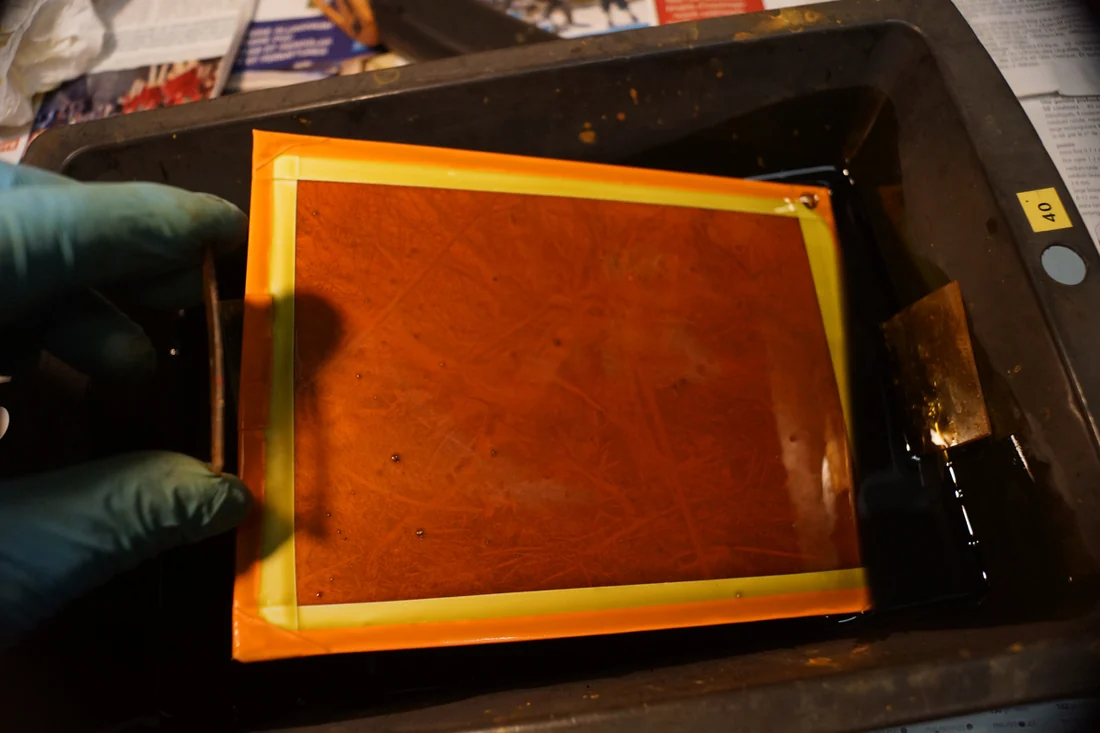
The rest is paid in fragility. Gelatin polymerised by free radicals is much weaker than gelatin hardened by chrome, and almost every step had to be rebuilt around that weakness. The peroxide bath has to be mixed fresh for every single plate, because after a few uses it loads up with the iron it has just liberated and stops making radicals. Development, which under dichromate runs at 56°C, has to be held at 40°C, or the highlights melt off the plate.
None of those numbers could be found one at a time. In photogravure, as he puts it, all the influential variables are interlocked, a little like a house of cards: finding the balance is very gradual, everything has to be in its right place, and each failure sends you back to requestion the rest.
What the fridge changed
Under dichromate, exposure commits you: you must go straight on to transfer the tissue to the copper and dry it, and only then can the etching wait until tomorrow. Citrate breaks the chain. The exposed paper can go in an envelope in the refrigerator, and the polymerisation, the transfer and the bite can happen days or weeks later.
He worked this out from the theory before he ever saw it in the studio, and it changed how the workshop can be run. He gives an example that is sitting there now: an image exposed on 28 June 2026, in the fridge ever since, waiting for him to take it up again after a summer that was too hot.
Nobody can tell
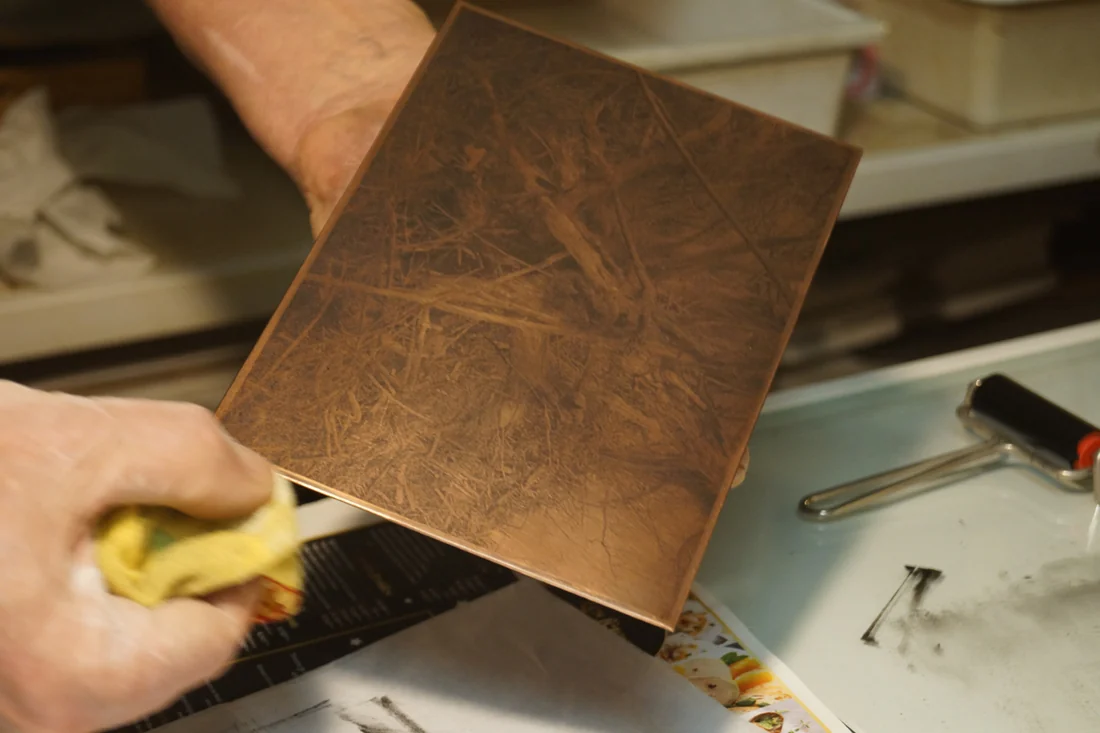
Put a dichromate gravure and a citrate gravure side by side and he sees no difference at all. Everything from the moment the gelatin reaches the copper is the same: the same ferric chloride, the same concentrations, the same times. Several dozen plates in, he reports no notable change in the tempo of the etch.
So the whole rebuild is invisible in the object. Months of ruined tissue, a chemistry taken apart and reassembled around a weaker material, and the print gives nothing away. Everything that changed happened upstream of the picture, which is the only place it could have changed and still be photogravure.
Not alone
He was not the only one who went back to that thesis, and he is exact about the order.
On 17 September 2023, in North Carolina, the printmaker Jennifer Page published her own log of ferric ammonium citrate photogravure on copper, crediting Bjørngård and the carbon printer Habib Saidane; she too had found DAS expensive, hard to get and not obviously safe. Sachy had read her results, and says they encouraged him to keep going. He knew Saidane’s work as well. He says he then pushed the work further than he might otherwise have done, because in Europe the chrome was banned outright and DAS had gone: he had nothing to fall back on. He published his own method on 4 February 2024, having waited until he had about ten successful plates and could repeat them.
So not a coincidence, and not a race. A Norwegian master’s thesis sat in a drawer for sixteen years, and then, within months of each other and on two continents, several people went and got it — because the chemicals they had been using had been banned or discontinued. The regulation wrote the rediscovery. His own way of putting it is that the use of citrate was found more or less simultaneously on two continents, and that it is a good thing both of them are named.
He can date all of it to the day because he has kept his research notes, written and dated, for years. That is how the work moves: every failure has a cause, and the cause is somewhere in the notes.
Everything given away
The whole process is on his website. Step by step, with the concentrations and the temperatures and the timings, free, and a printable PDF of the lot.
All my ‘manufacturing secrets’ are there, described explicitly on my website. I would say that is my philosophy, no doubt because I found myself confronted, at the beginning of my self-taught research, with a total lack of training, few written documents or videos on the process.
Hervé SachyHe has a chemist’s training — several university years in chemistry and toxicology — which is why he can mix a dilution and reason backwards from a fault to its cause. The rest came from books, of which there are not many, from forums, and from a very large number of trials.
He taught dichromate photogravure from 2015, the same technique with DAS from 2017, and citrate now. Two of his recent students have made their first successful citrate gravures, and he answers questions by WhatsApp when they get stuck. For a photogravure printer there is nothing to unlearn: everything after the gelatin reaches the copper is identical, and only the steps before it changed.
Which closes the circle he started in. He would not go on making pictures with a plate somebody else had coated, so he took the process back to the first step and kept it there. A method that only he knew would have put everybody else in exactly the position he had refused — so he wrote it all down and gave it away. A hundred and sixty-five years of a process depended on a carcinogen; the carcinogen was withdrawn; and the technique survived because two or three people with no funding rebuilt its chemistry and then told everyone how.