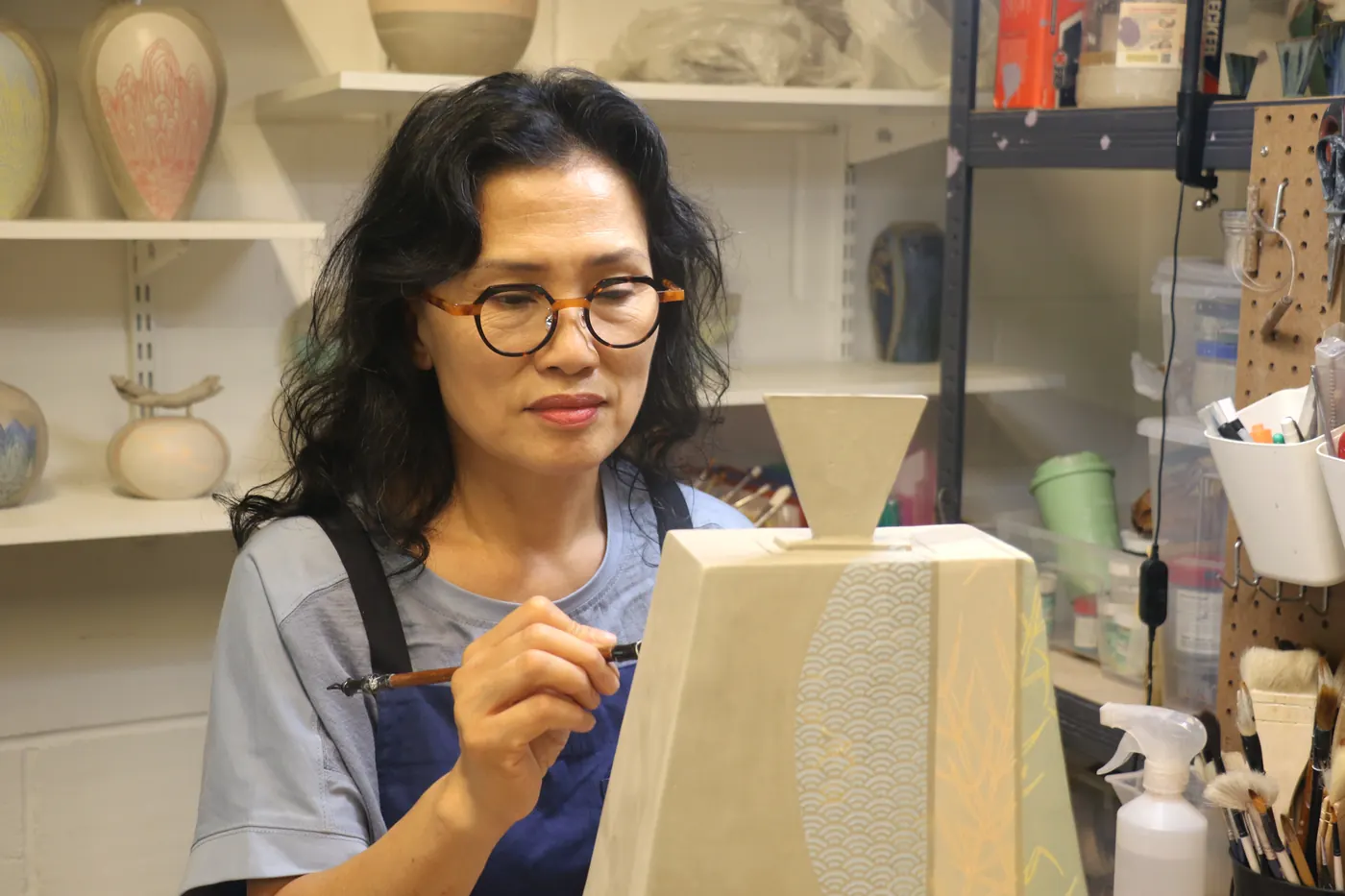
Paper should not survive a kiln. That is the first fact Jongjin Park refuses. In Seoul he dips recycled sheets—milk-carton stock, not romantic hand-made rag—into coloured porcelain slip, folds them, stacks them by the hundred and the thousand, then fires until the paper burns away. What is left keeps every crease. Softness becomes mineral. The eye still reads textile; the hand meets stone.
For that tension he won the 2026 LOEWE FOUNDATION Craft Prize: Strata of Illusion, a rectangular form with an open top and a side that slumps, as if geology had learned to slouch. Thirty finalists from more than five thousand submissions; nineteen countries; a free exhibition at the National Gallery Singapore. Fifty thousand euros for a object that looks ready to collapse and will not.
Flexible, not fragile
Park, professor of craft and collectible design at Seoul Women's University, rejects the usual language of unfired clay. Pre-fire is not weakness; it is the state where pattern, colour and form can still be negotiated. Layers become both metaphor and method—time made visible as sediment. He speaks of thinness and density, flexibility and rigidity, coexisting in one structure. The kiln does not erase the paper's memory. It archives it in porcelain.
Technical honesty matters here. Specialised kilns with high chimneys manage the exhaust of mass combustion; the ethics of burning paper are not waved away. This is not Instagram alchemy. It is industrial care applied to a domestic material. Readers of this magazine who defend the visible hand will recognise the weather: skill you can still see after the marketing has left the room.
A prize that wants to be a museum
The LOEWE prize, founded in 2016 under Jonathan Anderson's craft agenda for the house, has always lived in the awkward space between luxury brand and serious making. That awkwardness is productive. A fashion house bankrolls a jury that includes figures such as Magdalene Odundo and sends shortlists to institutions from Madrid to Singapore. Craft is not a side-table for the boutique; it is the argument that luxury once meant problem-solving at the edge of material possibility.
Special mentions this year—jewellery and collaborative weaving among them—remind you the field is wide. Park's win is not a coronation of ceramics alone. It is a vote for process that leaves a readable scar. Compare the slow leather discipline of Kenton Sorenson's shears cases: different medium, same refusal of speed as virtue.
The luxury of a crease
The dissenting note is fair. Luxury craft prizes can aestheticise labour while the supply chains of the sponsoring houses remain contested. Park's answer is not a manifesto about capitalism. It is a form that looks like failure and is not—one wall caving inward, pastel bands and frayed edges, geological permanence borrowed from studio geology outside Seoul. Decay as composition, not as brand story.
In a season of machines that print any vessel on demand, the rarer object is the one that required the artist to invent a kiln practice for disappearing paper. Fire does not destroy the fold. It makes the fold permanent. That is craft's oldest promise, restated without nostalgia: attention, heat, and a material that remembers what you did to it.