
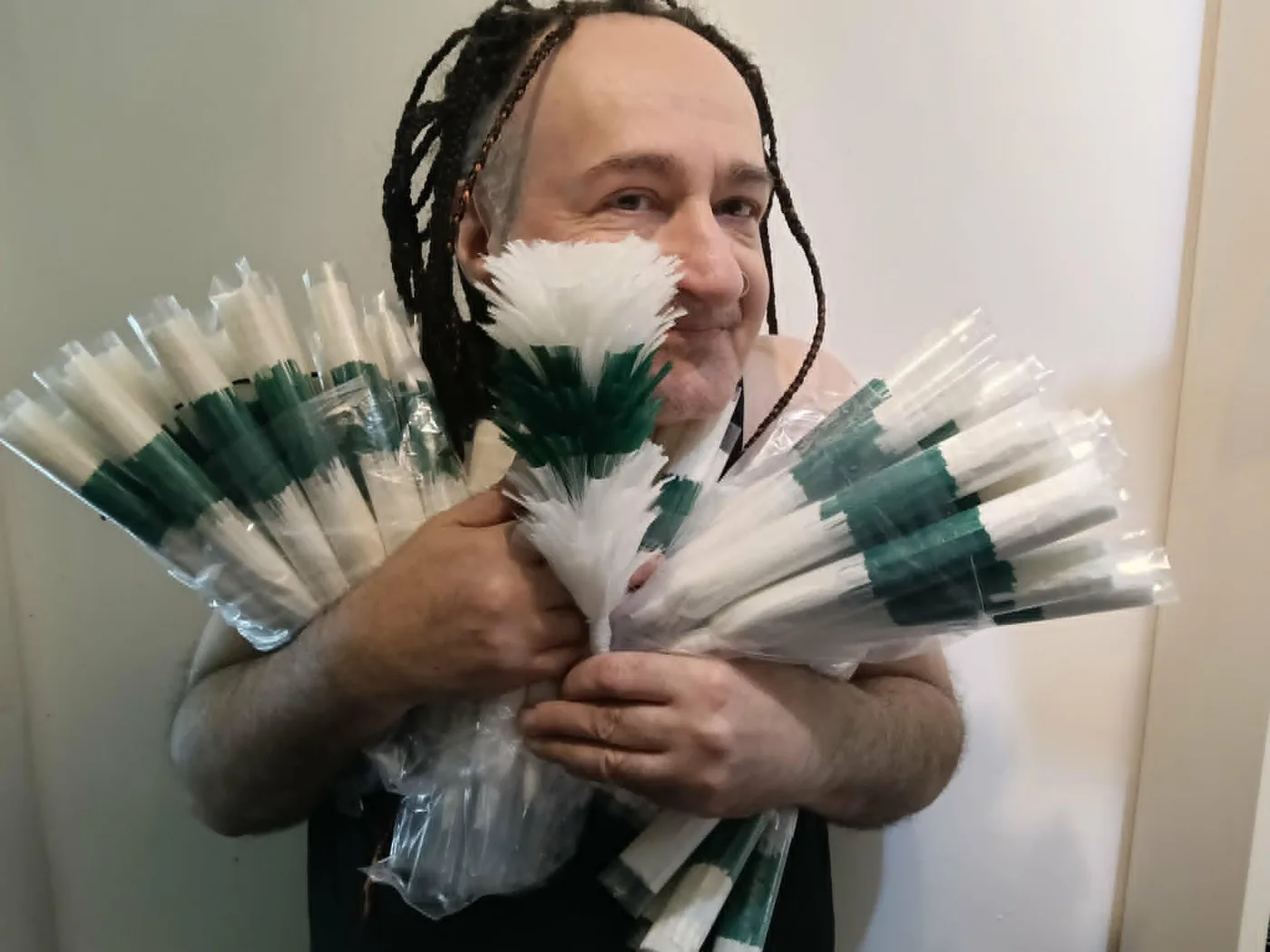
An officer of the Grenadier Guards was to stand vigil at the coffin of Queen Elizabeth II. His horse had died. He asked whether the plume for his bearskin could be made from the tail of that horse, and Louis Chalmers made it.
Chalmers is the man the British Army comes to for the things it wears on its head. Sixty patterns of ceremonial dress pass through his workshop. He also wrote the regulations that say what those patterns are — and his is one of two benches in Britain that can still meet them.
The King’s birds
The plume on a British general’s cocked hat is made of swan feathers. Mute swans on open water in Britain belong to the Crown, by a right the monarch has held since the twelfth century; King Charles III is Seigneur of the Swans. The claim covers dead birds as well as live ones, and any part of them. Under the Wildlife and Countryside Act it is an offence to possess part of a wild bird, and a man found with a moulted swan feather must prove he came by it lawfully, rather than anyone proving he did not.
So the feathers cannot be bought, farmed or ordered. They have to be found.
Swan feather plumes are the hardest. First, you need to legally obtain the feathers, this means humanely gathered, so someone has to actually pick them up off the ground.
Louis ChalmersHe makes about six general officer plumes a year, and believes he is the only person in the world who makes them at all — not because the skill is guarded, but because, as he puts it, there was never a massive demand. A general wears his once a year. It takes four weeks and cannot be hurried.
The materials are ranked as strictly as the men who wear them. Other ranks of the Household Cavalry wear horsehair; their officers wear fine yak. Many plumes are clipped cockerel. Highland feather bonnets are ostrich. Swan is for generals and colonial governors, which means the hardest plume to make is the one worn by the people who wear it least.
He wrote the rules
British Army uniform runs on sealed patterns. An approved specimen is held by the Ministry of Defence or the regiment; a maker produces a counter sample; the two are compared, and only then does a contract pass. It is a system for making sure a thing is right, and it presumes somebody knows what right is.
I wrote the dress regs for plumes for the MoD.
Louis ChalmersRegiments come back to him to find out what they are supposed to be wearing — usually a band, usually before something public. When he does not know either, he telephones a friend in Yorkshire who knows everything ever worn.
Two men, then, and a telephone, hold the answer to what the British Army is entitled to put on its head.
Then the orders went elsewhere
In 2015 the orders stopped. The plumes he had made for thirty years began to be produced in Pakistan instead.
The people who get handed one of my samples and told to copy it are very skilled, they learn quickly and do a good job.
Louis ChalmersWhat keeps him in business is distance. “I’m only a stone’s throw from Horse Guards Parade, which is why I’m still here.” A plume that needs mending the week before a parade has to be mended by somebody within reach.
I can usually tell at a glance, not just if it were made by us or Pakistan, but I can usually recognise that if it was made by us, which worker of mine had made it.
Louis ChalmersWhat it takes
A plume is not a bunch of feathers tied together. The raw material arrives as it came off the animal and is sorted by hand, fibre by fibre; anything broken, short or off-colour is thrown out. What survives the sort still carries the creature’s own oils, along with grit and dried blood, and has to be washed and degreased before it will take dye evenly or hang properly. Then it is dyed, and the colour has to survive years of London rain and parade-ground sun without going patchy. Only then is there any building to do: the hair or feather is bound onto a wire frame stiff enough to hold its shape, slim enough to slide behind a cap badge or into a brass socket on a helmet. Then it is bound off, steamed and shaped, which is the only point at which the thing starts to look like the object everyone recognises.
Most of the work, in other words, happens before anything looks like a plume. It is also where one can be ruined invisibly: a bad wash, or a dye that will let go in the third summer.
Paid for by the pictures
The Plumery is not, on paper, a plume company. Chalmers is director of Insurgent Films Ltd, incorporating The Plumery: the military work sits inside a film business, and the film business is a good part of what keeps it alive.
Costume designers, in his experience, “are seldom interested in authenticity and accuracy. Certainly not in Troy or either Gladiators.” Troy dressed a Bronze Age war in something closer to classical hoplite gear. There was one exception, Oliver Stone’s Alexander, where the designer “actually sought out historical costume accuracy” — that was Jenny Beavan, working with the Oxford classicist Robin Lane Fox. On Gladiator II: “I managed to use historically accurate methods to create the Roman legionary plumes, rather than a glue gun.”
The same bench has made horsehair fringes for Alexander McQueen, headdresses for Katharine Hamnett, and costumes for pole dancers. An army that demands total conformity and a fashion house that demands the opposite are served by the same hands, and the second pays for the first.
The moths
State occasions bring less work than you would think. The Army already owns enough plumes for Trooping the Colour or a dead monarch. The exceptions are the general officers, who wear theirs once a year, take them off the shelf and find the moths have been at them. He repairs what he can. A general’s plume cannot be made in under four weeks, and a coronation does not wait.
The true emergency of a British state occasion is entomological: an insect, a shelf, and feathers that can only be gathered one at a time, off the ground.
Two firms
Plume making entered the Heritage Crafts Red List as Critically Endangered in 2023, and is there again in the 2025 edition. The entry names two businesses. One is The Plumery. The other is Jaffé et Fils, who dye feathers and horsehair and make plumes from the raw materials. That is the whole of it: sixty patterns of British Army ceremonial dress, two firms.
Chalmers came to it at nineteen, sent to Appleton Bros by the job centre as an unemployed youth. The firm had been making plumes since the Napoleonic wars; what survives of it now makes wool tapestry. He was taught by Nellie Smith MBE, who had started there at fourteen in 1918, when full dress came back. When the old directors died and the younger ones were not interested, he bought the plume department off them, and The Plumery is what he made of it.
There are all sorts of small makers of British army ceremonial kit that are becoming extinct, we are vanishing faster than a Dodo at a Brasserie. There is a skill extinction event going to happen over the next 20 years.
Louis ChalmersWhat would be lost is not a look. A sealed pattern only works if somebody can still meet it; a dress regulation only means something if somebody can read it into an object. Chalmers wrote the text, and his bench is one of two places left that can execute it. If those go, the regulations survive as a description of things no one in Britain can any longer make.
None of them fail, they all look fucking awesome, or they look ridiculous, I’ve never actually decided which.
Louis ChalmersA feather that legally belongs to the King, picked up off the ground by hand, built over four weeks into an object a general wears once a year. Somebody still has to decide how it is done. For now that is him, and a friend in Yorkshire, and a telephone.